I have been internally debating returning to this blog for about a month now. It isn't that I don't like posting my thoughts. It isn't because my readership is minimal (I write for myself before I write for anyone else). It isn't even because I don't normally have the time handy that it takes to sit down, brood, and write. That is a continual problem, but one that can be overcome with a little bit of planning and awareness. The reasons for avoiding this blog are actually beyond me. Sometimes it feels like a child's toy that's been played with until the thought of picking it up again and entering that wonderful, imaginary world, for some reason, doesn't possess the same compelling feeling. Or like a movie you know you love no matter how many times you have viewed it, and yet, even on your greatest day of boredom, you can't bring yourself to pop it in the player again.
I suppose healing to such avoidance-behavior can only be found by picking that ol' action figure up again, popping that dusty videotape back into the VCR, and forgetting about yourself long enough to allow something to bless you, even if you believe it is a foregone possibility. Hence this, my first post in several months, which finds the structure in the telling of a couple of good experiences had over the past month.
Rejuvenation
I began my year by attending a week-long retreat in Kerrville, sponsored by the Truett Seminary Center for Effective Preaching. Technically an "I-term" seminary class, I was glad to find that I was not the only graduate in the group. I reunited with several friends from my days at DaySpring in Waco, and we joined with several current students for what was entitled "Imaginative Reading for Creative Preaching."
The week was a true blessing. As 2007 drew to an end, I felt like I was running on fumes, as rickety and unsure upon the journey as my old, rapidly-deteriorating Jeep (which, thankfully, carried me to Kerrville and back safely nonetheless). But this retreat/class was like pulling up to the pumps and topping off the tank. I was rejuvenated in both my reading and my writing, so much so that even during the free afternoons, while the current students were cramming and reviewing their notes (ah, the joy of not having to worry about grades anymore), I sat out on the spacious backside of our cabin, softly rocking back and forth in an old, wooden porch chair, and tapped away on my novel, feeling as if something had been restarted within me. I was the Energizer Bunny who had finally - finally - run out of juice, only to be saddled with a brand new charge. I left the retreat with a sad heart, having been reminded how wonderful seeking deep, challenging truth in community could be. It was a long, quiet, reflective drive back to Houston.
Healing
The other piece of devotion that was kick-started, both by the retreat as well as simply by the obligatory resolutions that come with the start of a new year, was a return to a time of contemplation, quietness, and prayer. Not only have Leigh and I begun to meet together one morning a week to pray both for our future - on the mission field - and the current issues filling our lives, but I have taken back up with renewed fervor the keeping of the daily office. The Book of Common Prayer has become even more invaluable to me than it was when I first purchased it our of sheer curiosity a few years ago. I am currently attempting to keep the 9:00, noon, and 5:00 hours of prayer, and I have found that the more I fashion this time as a mini-retreat, the greater sense of importance it inhabits within me. At the office or at home, I shut all the window blinds, clear my desk, light candles, and read the selected psalms, readings, and collects out loud. I've even been incorporating some different styles of chant. So, I guess I'm still perpetuating my wannabe Catholic-ness. Then again, it would be more accurate to call it a wannabe Episcopalian-ness.
The best apart about all of this, is that I have not returned to these things (writing, meditation, prayer) out of guilt, but out of a real desire to revisit the intimate, mysterious connection these things afforded me with God. Growing up, I was always guilted into "quiet times" and Scripture memorization ... and then guilted all the more when I "backslid" from such things. It has surprised me how a prolonged separation of genuine seeking and centering can cause a person to make the effort all by him - or her - self. I guess we're never completely lost, no matter who may tell us so. After all, the writer of Hebrews reminds us that, "when we are faithless, he will remain faithful, for he cannot deny himself." It is this saving reality that produces hope when it seems all hope is lost. No matter how far I fall, no matter how rebellious my actions, no matter how impure my thoughts, no matter how destructive my words - there is one I cannot shake from my shoulders no matter how violently I may writhe for freedom.
Jacob wrestled with the angel, but even in his strength and persistence, he did not walk away a winner. He did, however, walk away a new man with a new name.
I suppose there are more bold, italicized topics I could include in here. I could write more about the progression of the novel, about the wonderful books I have been reading, the contemplative prayer service I am going to be leading every week of Lent, or my plans for Ash Wednesday (which includes catching an evening concert by the rarely-outside-of-Ohio duo, Over the Rhine). I could talk about my scary addiction to FIFA Soccer on Xbox, or the new car my wife bought me for Christmas that finally arrived a week ago.
I could talk about a lot of things, but none would be more wonderful and wonder-filled to me than the two mentioned. I am rejuvenated, even in the face of a new calendar year and a lot of new responsibilities. And I am healed, even while the lingering smell of running on fumes still returns to my nose from time to time. But it's a continuous thing, these blessings, and win or lose, no one ever said wrestling was easy.
Showing posts with label Of a Contemplative Nature. Show all posts
Showing posts with label Of a Contemplative Nature. Show all posts
Thursday, January 31, 2008


Sunday, September 23, 2007
At Vacation's End
One hundred posts deserved a vacation - an escape from the blog. And that's exactly what I took - a blog vacation. Since the inception of this thing, hardly a day would go by when I wouldn't feel an idea seize me. I would be in my car, sitting in traffic and listening to some song ... or leaning back in my chair at my desk trying to decide what item on my to-do list to tackle next ... or simply lying in bed, unable yet to sleep, staring up into the darkness, ideas spinning in my mind like the blades of the ceiling fan.
I'm happy for the ideas - the way they blindside me. Growing up, it was made clear to me by my parents and my own experience that "nothing is free in this world." But the ideas are ... and maybe that's a picture of grace.
More than a picture. Maybe that grace.
Nevertheless, August and September, when you work for a traditional church, are oftentimes hectic months. The last eight weeks have been spent writing Sunday School curriculum for the whole church, creating, planning, and establishing three new Sunday morning Bible study classes for the Student Ministry, putting together a fall calendar, and coping with the return of 800 grade school kids to the church school, which includes a lot more activity in the new building where my office is located thanks to a brand new dining service. Seriously, these kids are eating grilled salmon, wild mushroom soup, organic fruit, and a whole load of other healthy, expensive foods that make the corndogs and nasty, slimy burritos from my high school cafeteria seem like the nutritional equivalent of child abuse.
Around Wednesday, the new amount of work can begin to weigh me down, but, strangely enough, by Sunday I'm ready for a new week, if only in anticipation of scratching more things off my to-do list. The problem has not been the busyness, but my response to the busyness. A few days ago, in one of those recurring reflective moments, I began to ponder how my life has (it seems almost involuntarily) reordered itself. I thought back to my days in New England, and even before that during college, when I would seek out quiet places and carve out hours of time to sit and read the Bible and Brennan Manning or Phillip Yancey books. I realize now much of my motivation to do so came from the false understanding that in some way I was earning my sanctification like a student earns a degree. But it occured to me that despite the motivation, these times were sacred for me, and no matter my level of understanding, I was communing with the Holy - I was participating in a beloved relationship.
And then came seminary ... and a shift in understanding ... and the struggle to authenticate my relationship, my times of communion. I would not trade anything for this time, even though I've discovered a bit of a nuerosis in how I approach - or fail to approach God - these days. But, hence, a reordering of my life. A new city, a new job, and a new marraige doesn't always help such a situation either. However, I sit here tonight on my couch in my living room, in one of these reflective moments, and I see that it doesn't hinder the situation either. It only changes it.
The correct response would be to change with it.
And so, a vacation from pouring out the reflections in my head has, if anything, freed me up to better embrace the busyness, and, ironically, it has brought me back into touch with the spirit of this thing, this blog. That is, to quiet myself. To get in touch with the wonder of life and report on it, not really for others so much as for me.
The relationship continues unabated ... and for now, so will the writing.
I'm happy for the ideas - the way they blindside me. Growing up, it was made clear to me by my parents and my own experience that "nothing is free in this world." But the ideas are ... and maybe that's a picture of grace.
More than a picture. Maybe that
Nevertheless, August and September, when you work for a traditional church, are oftentimes hectic months. The last eight weeks have been spent writing Sunday School curriculum for the whole church, creating, planning, and establishing three new Sunday morning Bible study classes for the Student Ministry, putting together a fall calendar, and coping with the return of 800 grade school kids to the church school, which includes a lot more activity in the new building where my office is located thanks to a brand new dining service. Seriously, these kids are eating grilled salmon, wild mushroom soup, organic fruit, and a whole load of other healthy, expensive foods that make the corndogs and nasty, slimy burritos from my high school cafeteria seem like the nutritional equivalent of child abuse.
Around Wednesday, the new amount of work can begin to weigh me down, but, strangely enough, by Sunday I'm ready for a new week, if only in anticipation of scratching more things off my to-do list. The problem has not been the busyness, but my response to the busyness. A few days ago, in one of those recurring reflective moments, I began to ponder how my life has (it seems almost involuntarily) reordered itself. I thought back to my days in New England, and even before that during college, when I would seek out quiet places and carve out hours of time to sit and read the Bible and Brennan Manning or Phillip Yancey books. I realize now much of my motivation to do so came from the false understanding that in some way I was earning my sanctification like a student earns a degree. But it occured to me that despite the motivation, these times were sacred for me, and no matter my level of understanding, I was communing with the Holy - I was participating in a beloved relationship.
And then came seminary ... and a shift in understanding ... and the struggle to authenticate my relationship, my times of communion. I would not trade anything for this time, even though I've discovered a bit of a nuerosis in how I approach - or fail to approach God - these days. But, hence, a reordering of my life. A new city, a new job, and a new marraige doesn't always help such a situation either. However, I sit here tonight on my couch in my living room, in one of these reflective moments, and I see that it doesn't hinder the situation either. It only changes it.
The correct response would be to change with it.
And so, a vacation from pouring out the reflections in my head has, if anything, freed me up to better embrace the busyness, and, ironically, it has brought me back into touch with the spirit of this thing, this blog. That is, to quiet myself. To get in touch with the wonder of life and report on it, not really for others so much as for me.
The relationship continues unabated ... and for now, so will the writing.
Thursday, August 09, 2007
Summer in the City
It is a disconcerting thing to wake up, morning after morning, in a big city. Especially one like Houston. It is not that this sprawling megatropolis has not grown on me in some respects, but it is so big, spread wide as far as the eye can see from the vantage points of highway overpasses, hectic with little slow down, and sweltering hot. Instead of a peaceful backyard, I wake and unfold the blinds to view painters and lawn workers moving back and forth along the apartment community sidewalks between my porch and other units less than a stone's throw away. I grab the dog's leashes and lament every morning that I cannot let them simply run wild, which is what I'm sure they long to do, but instead must hold them back so that, in their desperate pull on the leashes, they look like sled dogs trudging through snow.
Except that there is no snow ... no countryside at all, really. Concrete mostly, and little spreads of grass.
It's not that I'm unhappy with where we live - our apartment and area of town - or with Houston in general. There are pros and cons to every city, every town. What I miss is the quiet. I miss long expanses of grass. Choruses of birds singing and not drowned out by weed-eaters, generators, and cars blasting by on the highway. I miss slowness. I miss calm.
The rigors of apartment life in a big city are nothing to complain about, really, so don't take this entry as proof of discontentment. It is a hope for adjustment as much as change. I want to live now, and not mourn the things I don't have. And yet...
This is my one hundredth post on this blog. One hundred entries. One hundred posts ago, I was living in Waco, attending seminary, searching for belonging in that place, living alone, feeling strangely part of a city and a small town all at once (Waco is strange in that way). I created this blog then to encourage myself not to shy away from expression, and to be mindful of all the little wisps of wonder that meander into our lives.
Sometimes I feel like that desire has been squelched by lost time and the big city. But it has not. It's still there, under the surface, and even my discouragement is proof of it.
Such a wish for slowness and rural country is helping me with my writing of late. The piece I'm currently at work on finds the protagonist debating his existence in a large city, and weighing the merits of retreating to a quieter, more homely place. But, of course, on the page I work now, he's still in the city, still searching, still struggling to find purpose in the midst of a thousand distractions, things that seem to lie in wait overnight and seize our attention as soon as our heads lift off the pillow and we swing our weary feet to the floor.
Leigh and her sister are visiting a friend in Wisconsin this week, and with mountains of work to do at the church in preparation for a new season of worship and activity, I'm stuck here in Houston. Driving her to the airport this morning along Beltway 8, my eyes fell sadly on rows of towering power line structures disappearing into the distance, and the way the scorching August sun glared off of them and created liquid-like waves of heat upon the asphalt. In that moment, the giant, metal towers could have been prison bars.
I realize wonder is an elusive thing, but sometimes I think I am just too lazy to seek it out. It's going to take some initiative, living here in the big city. For my sake, I hope I've got it in me.
Except that there is no snow ... no countryside at all, really. Concrete mostly, and little spreads of grass.
It's not that I'm unhappy with where we live - our apartment and area of town - or with Houston in general. There are pros and cons to every city, every town. What I miss is the quiet. I miss long expanses of grass. Choruses of birds singing and not drowned out by weed-eaters, generators, and cars blasting by on the highway. I miss slowness. I miss calm.
The rigors of apartment life in a big city are nothing to complain about, really, so don't take this entry as proof of discontentment. It is a hope for adjustment as much as change. I want to live now, and not mourn the things I don't have. And yet...
This is my one hundredth post on this blog. One hundred entries. One hundred posts ago, I was living in Waco, attending seminary, searching for belonging in that place, living alone, feeling strangely part of a city and a small town all at once (Waco is strange in that way). I created this blog then to encourage myself not to shy away from expression, and to be mindful of all the little wisps of wonder that meander into our lives.
Sometimes I feel like that desire has been squelched by lost time and the big city. But it has not. It's still there, under the surface, and even my discouragement is proof of it.
Such a wish for slowness and rural country is helping me with my writing of late. The piece I'm currently at work on finds the protagonist debating his existence in a large city, and weighing the merits of retreating to a quieter, more homely place. But, of course, on the page I work now, he's still in the city, still searching, still struggling to find purpose in the midst of a thousand distractions, things that seem to lie in wait overnight and seize our attention as soon as our heads lift off the pillow and we swing our weary feet to the floor.
Leigh and her sister are visiting a friend in Wisconsin this week, and with mountains of work to do at the church in preparation for a new season of worship and activity, I'm stuck here in Houston. Driving her to the airport this morning along Beltway 8, my eyes fell sadly on rows of towering power line structures disappearing into the distance, and the way the scorching August sun glared off of them and created liquid-like waves of heat upon the asphalt. In that moment, the giant, metal towers could have been prison bars.
I realize wonder is an elusive thing, but sometimes I think I am just too lazy to seek it out. It's going to take some initiative, living here in the big city. For my sake, I hope I've got it in me.
Friday, April 06, 2007
A Good Friday Re-Post: Extinguished
The last few months have found me stretched close my limit. Continual stresses, plan after plan to form, schedule after schedule to make. One would think such business in planning a wedding would be more of a hindrance for people marrying again and again, but I cannot say there is not joy in the planning, as hard to find as it sometimes is.
With all these distractions, it has been near impossible to post regularly, and I fear I will not be able to write much more until the end of April (if then!) as I am coming down to the last week (what was I thinking to attempt a two-part response post - though I do intend to finish, it will have to wait a little longer). But arguably more important than next week is the week we are presently in. I sit now in my office after participating in my church's Good Friday service, and I am struck once again by the sadness, overcome as in years past with the melancholy. To mark this occasion, one I feel to be the most poignant moment in the Church Year, if not the most important (many would argue the coming celebration of Easter holds a smidge more sway), I offer again to my readers the reflection on Good Friday I wrote last year. What follows is a reprint of the entry, "Extinguished."
___________
It is finished.
Jesus is captured. He is rejected. He is despised. He is mocked.
The Lord, the Christ, has taken upon himself the sins of the world. As man, he is the only one who stands outside the arena of guilt and rebellion in which we all are gathered. As God, he puts aside all that it means to be God (power, glory, justice, reign, sovereignty) and steps silently into this savage arena. With only whispered words, fragments of a holy conversation lost on the ears of all who surround him, he subjects himself to our brutal, impatient violence. We pour out upon him all our misguided wrath, and as it was foreshadowed by prophets, such undeserved punishment pleases the Creator, who in misery and sorrowful acceptance, stays his hand from turning back upon us the wrath we gleefully pour out.
It is finished.
Jesus is stricken. He is wounded. He is bruised. He is pierced.
The Lord, the Christ, bows his head and enters a place no god would dare trod. He gives himself over to those who could never foresee, do not comprehend, and perhaps still will never understand who he is, and what he has done. Saturated with our spit, soggy with his own blood, torn and flayed, no one in this dark arena sees the mystery. Before our eyes, manifested, incarnated, is the Mystery of Grace. It is a mystery he dies. It is a mystery he allows a single blow to land upon him, allows but one hand to arrest him, yoke him. It is a mystery he enters this arena in the first place.
It is finished.
Jesus is dead. The Christ is dead. The Lord is dead. Our God is dead.
The Lord, the Christ, is laid in a tomb. The sky over the arena is black. A peal of thunder, and we who inhabit the arena could swear we hear the anguished roar of the Creator. Our tumult settles. The din falls silent. We witness a stone heaved over the tomb and sealed. The choked, dying words descends upon the arena floor: "It ... is ... finished." We answer with whispers choked with our shock. What have we done? And yet, this day is Good. This is Good Friday. The Mystery of Grace is dead, yet lingers. Like a fog refusing to dissipate, we are surrounded by tragedy mixed with wonder, grief mixed with reverence, guilt mixed with awe.
It is finished.
The lights fade and go out. The candles are extinguished. All is dark.

What Thou, my Lord, hast suffered, was all for sinners’ gain;
- Bernard of Clairvaux
With all these distractions, it has been near impossible to post regularly, and I fear I will not be able to write much more until the end of April (if then!) as I am coming down to the last week (what was I thinking to attempt a two-part response post - though I do intend to finish, it will have to wait a little longer). But arguably more important than next week is the week we are presently in. I sit now in my office after participating in my church's Good Friday service, and I am struck once again by the sadness, overcome as in years past with the melancholy. To mark this occasion, one I feel to be the most poignant moment in the Church Year, if not the most important (many would argue the coming celebration of Easter holds a smidge more sway), I offer again to my readers the reflection on Good Friday I wrote last year. What follows is a reprint of the entry, "Extinguished."
___________
It is finished.
Jesus is captured. He is rejected. He is despised. He is mocked.
The Lord, the Christ, has taken upon himself the sins of the world. As man, he is the only one who stands outside the arena of guilt and rebellion in which we all are gathered. As God, he puts aside all that it means to be God (power, glory, justice, reign, sovereignty) and steps silently into this savage arena. With only whispered words, fragments of a holy conversation lost on the ears of all who surround him, he subjects himself to our brutal, impatient violence. We pour out upon him all our misguided wrath, and as it was foreshadowed by prophets, such undeserved punishment pleases the Creator, who in misery and sorrowful acceptance, stays his hand from turning back upon us the wrath we gleefully pour out.
It is finished.
Jesus is stricken. He is wounded. He is bruised. He is pierced.
The Lord, the Christ, bows his head and enters a place no god would dare trod. He gives himself over to those who could never foresee, do not comprehend, and perhaps still will never understand who he is, and what he has done. Saturated with our spit, soggy with his own blood, torn and flayed, no one in this dark arena sees the mystery. Before our eyes, manifested, incarnated, is the Mystery of Grace. It is a mystery he dies. It is a mystery he allows a single blow to land upon him, allows but one hand to arrest him, yoke him. It is a mystery he enters this arena in the first place.
It is finished.
Jesus is dead. The Christ is dead. The Lord is dead. Our God is dead.
The Lord, the Christ, is laid in a tomb. The sky over the arena is black. A peal of thunder, and we who inhabit the arena could swear we hear the anguished roar of the Creator. Our tumult settles. The din falls silent. We witness a stone heaved over the tomb and sealed. The choked, dying words descends upon the arena floor: "It ... is ... finished." We answer with whispers choked with our shock. What have we done? And yet, this day is Good. This is Good Friday. The Mystery of Grace is dead, yet lingers. Like a fog refusing to dissipate, we are surrounded by tragedy mixed with wonder, grief mixed with reverence, guilt mixed with awe.
It is finished.
The lights fade and go out. The candles are extinguished. All is dark.
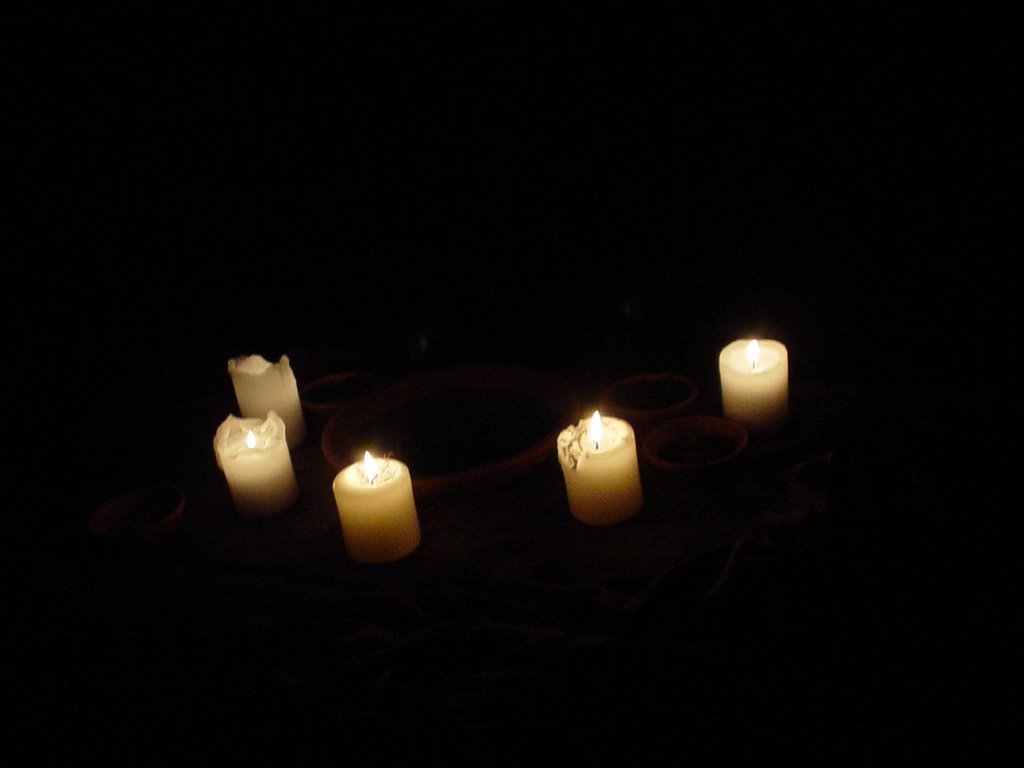
What Thou, my Lord, hast suffered, was all for sinners’ gain;
Mine, mine was the transgression, but Thine the deadly pain.
Lo, here I fall, my Savior! ’Tis I deserve Thy place;
Look on me with Thy favor, vouchsafe to me Thy grace.
- Bernard of Clairvaux
Thursday, March 08, 2007
Leaving the Runway
Last night, I spoke with some of the youth at the church about "The Lost Tomb of Jesus," the docu-drama that has created an incessantly annoying buzz in the worlds between the media and academia, especially archaeological, scriptural, and theological studies. To read more about this ridiculous documentary, go here, or here, or, for more scholarly information and links, go here.
What was interesting to me is what has been going on inside me, in my mind and my spirit, while I debate and refute this documentary and the claims it makes. I explained last night to the youth that when stuff like this pops up in the news and culture, Christians will normally react in three different ways. 1) They will spiral into a pissed-off realm of reactivity and begin lambasting Hollywood, Jews, skeptics, science, and whatever and whomever else they feel has done the cultural and media equivalent of stalking down the aisles of our churches and slapping our pastor in the face. 2) They will become increasingly paranoid, whether because they worry that something discovered might shatter their faith, or that their weak faith won't be able to stand up to the pressure that some discovery, valid or not, will do when it invokes its own defendants hungry for a debate of the facts. 3) They will embrace the dialogue, excited for the chance that some people will take themselves and their religious interest serious enough for a while in which a calm, collected Christian might be able to persuade them to tweak their worldview to include faith in a mystery.
Inside, while I'm explaining all this, I feel uneasy, because I suspect I am undulating somewhat between the latter two. I feel as if I am bouncing back and forth sometimes. It is hard not to be paranoid. Belief built on faith and not proof has a tendency, at times, to cause trepidation in a person if someone claims to have proof to the contrary. As much as I believe this whole "discovery" is, in reality, completely incorrect in what its proponents are claiming it is, I still cannot shake some of the residual paranoia that finds its way into my bones, and, uniting with my love of dialogue and debate, threatens to make me like the first kind of Christians mentioned above.
Why is it so difficult to leave behind this desire for proof? Why does faith in the mystery sometimes feel like a burden rather than a blessing? The ambiguity of the gospels, the selectivity of the New Testament writers, the odd faith of it all, can be hard to maintain at times, and even harder to live convincingly before those who feel that they need more, who feel that they need proof.
As I spoke with some of the confused youth last night (that seems to be a pattern most Wednesdays, that I leave some of them more confused than when they came in), I tried to illustrate the purpose of faith beyond proof to them, as it is central to the Christian life. "It's like a plane taxiing down a runway," I explained. "The runway is proof. It's grounded. It's solid. It's sure. You're almost certainly safe on the runway. But, if you're going to get from here to your true destination- if your faith in God is going to fly - then, eventually, you have to take off. You have to leave the solidity of the ground for the freedom, and hopeful uncertainty, of the wide open sky. Otherwise, you'll just taxi around in circles and never get anywhere."
If we are to fly, the proof must fade into hope. In both is faith, but the goal of faith is found somewhere on the other side of the horizon.
What was interesting to me is what has been going on inside me, in my mind and my spirit, while I debate and refute this documentary and the claims it makes. I explained last night to the youth that when stuff like this pops up in the news and culture, Christians will normally react in three different ways. 1) They will spiral into a pissed-off realm of reactivity and begin lambasting Hollywood, Jews, skeptics, science, and whatever and whomever else they feel has done the cultural and media equivalent of stalking down the aisles of our churches and slapping our pastor in the face. 2) They will become increasingly paranoid, whether because they worry that something discovered might shatter their faith, or that their weak faith won't be able to stand up to the pressure that some discovery, valid or not, will do when it invokes its own defendants hungry for a debate of the facts. 3) They will embrace the dialogue, excited for the chance that some people will take themselves and their religious interest serious enough for a while in which a calm, collected Christian might be able to persuade them to tweak their worldview to include faith in a mystery.
Inside, while I'm explaining all this, I feel uneasy, because I suspect I am undulating somewhat between the latter two. I feel as if I am bouncing back and forth sometimes. It is hard not to be paranoid. Belief built on faith and not proof has a tendency, at times, to cause trepidation in a person if someone claims to have proof to the contrary. As much as I believe this whole "discovery" is, in reality, completely incorrect in what its proponents are claiming it is, I still cannot shake some of the residual paranoia that finds its way into my bones, and, uniting with my love of dialogue and debate, threatens to make me like the first kind of Christians mentioned above.
Why is it so difficult to leave behind this desire for proof? Why does faith in the mystery sometimes feel like a burden rather than a blessing? The ambiguity of the gospels, the selectivity of the New Testament writers, the odd faith of it all, can be hard to maintain at times, and even harder to live convincingly before those who feel that they need more, who feel that they need proof.
As I spoke with some of the confused youth last night (that seems to be a pattern most Wednesdays, that I leave some of them more confused than when they came in), I tried to illustrate the purpose of faith beyond proof to them, as it is central to the Christian life. "It's like a plane taxiing down a runway," I explained. "The runway is proof. It's grounded. It's solid. It's sure. You're almost certainly safe on the runway. But, if you're going to get from here to your true destination- if your faith in God is going to fly - then, eventually, you have to take off. You have to leave the solidity of the ground for the freedom, and hopeful uncertainty, of the wide open sky. Otherwise, you'll just taxi around in circles and never get anywhere."
If we are to fly, the proof must fade into hope. In both is faith, but the goal of faith is found somewhere on the other side of the horizon.
Wednesday, December 13, 2006
Voice in the Wilderness
They will come when they realize it. They will come because they need release from it. They will come for this, but it is not release I offer so much as the hard gift of preparation, of expectancy. I stand on the outskirts, the natural wilderness just beyond the concrete one. My feet are ankle-deep in the brown water, my throat is sore from the shouting, and my skin is pricked by the midnight cold. Though I am accustomed to all of this, I do not relish the feelings, but I relinquished my feelings and my comforts and my pride and my shame and my misguided "better" ideas some time ago. It is the only way I can do what I do.
Perhaps they will come tomorrow. Perhaps tomorrow they will realize who they are and where they are - what they are - and they will hear my commotion or hear of it, and they will wander down to this dirty water, to the hoarse shouting man standing in it, and they will listen and ponder and suspect their need for release, and they will gently and timidly touch a toe into the water as if it were white fire, and then step in and wade out, and stand next to me ... and then I tell them I cannot give them release, but only the hard gift of preparation, of expectancy.
But this is what they need. If it is release they seek, they must first step into this water for preparation. They must first understand their need for expectancy. They will desire release - yearn for it - but too many comfortable, prideful others are hocking release in their faces everyday, and such sales pitches are wearing thin. Those vendors have no tremble in their voice, no hoarseness, no bare feet in brown water, nothing but better ideas, and if I know anything, I know there is no better idea than the Idea itself.
Perhaps they will come tomorrow. When they realize it, they will come. And until then, I will continue to cry out, for as much as I am the preparer, I must also be prepared. I also wait with expectancy, for it is this same release I, too, am seeking.
Perhaps they will come tomorrow. Perhaps tomorrow they will realize who they are and where they are - what they are - and they will hear my commotion or hear of it, and they will wander down to this dirty water, to the hoarse shouting man standing in it, and they will listen and ponder and suspect their need for release, and they will gently and timidly touch a toe into the water as if it were white fire, and then step in and wade out, and stand next to me ... and then I tell them I cannot give them release, but only the hard gift of preparation, of expectancy.
But this is what they need. If it is release they seek, they must first step into this water for preparation. They must first understand their need for expectancy. They will desire release - yearn for it - but too many comfortable, prideful others are hocking release in their faces everyday, and such sales pitches are wearing thin. Those vendors have no tremble in their voice, no hoarseness, no bare feet in brown water, nothing but better ideas, and if I know anything, I know there is no better idea than the Idea itself.
Perhaps they will come tomorrow. When they realize it, they will come. And until then, I will continue to cry out, for as much as I am the preparer, I must also be prepared. I also wait with expectancy, for it is this same release I, too, am seeking.
Tuesday, November 07, 2006
Flight
I stand upon the precipice, leaning at the edge. There is a strong updraft gusting; it tries to keep me from leaning too far. But for the familiar fear residing in my mind, my whole being desires to separate from the ground under my feet and soar into the wild, boundless sky. It is an unknown, frightening blue sea, but no more dangerous than the dusty dirt beneath my feet in which I have placed far too many footprints.
I know I cannot simply jump. My mind won't allow it, nor will the updraft. I am held fast in place, flirting with the edge, unable to free myself. Unable to fly. I have done all that I feel I can - I have stepped to the edge and peered out into the sky. My heart is filled with a desire for so many possibilities that do not exist upon land, but are rumored to lie somewhere within the wild blue stretching out endlessly before me. To get there, however, will take more power than I possess on my own. Strength to overcome my own hesitation and the guarding, gusting wind here at the edge.
I do not need merely a holy nudge, but a holy shove. A confident push that will separate me. Perhaps I will only plummet to the rocks far, far below, but even in such a crash there is more wonder and excitement than when I fall here on land. Falling here is but a pathetic scrape of the knee. Falling out there is a glorious destruction. Everything out there is better, is truer, is wild and unpredictable.
Deep down, beyond my present fear, I believe a real life is one lived in flight. I need this wildness. I need the unknown.
But first, I need a holy shove.
I know I cannot simply jump. My mind won't allow it, nor will the updraft. I am held fast in place, flirting with the edge, unable to free myself. Unable to fly. I have done all that I feel I can - I have stepped to the edge and peered out into the sky. My heart is filled with a desire for so many possibilities that do not exist upon land, but are rumored to lie somewhere within the wild blue stretching out endlessly before me. To get there, however, will take more power than I possess on my own. Strength to overcome my own hesitation and the guarding, gusting wind here at the edge.
I do not need merely a holy nudge, but a holy shove. A confident push that will separate me. Perhaps I will only plummet to the rocks far, far below, but even in such a crash there is more wonder and excitement than when I fall here on land. Falling here is but a pathetic scrape of the knee. Falling out there is a glorious destruction. Everything out there is better, is truer, is wild and unpredictable.
Deep down, beyond my present fear, I believe a real life is one lived in flight. I need this wildness. I need the unknown.
But first, I need a holy shove.
Friday, March 10, 2006
A Call to Be Quiet
At my church's lectionary breakfast today, choral director Kurt Kaiser analogized the shallowness of many a church-goer's faith with music (a metaphor he is apt to employ with any number of issues). He called them "praise & worship Christians," and by this he was referring to what he views as one of the most significant problems (even dangers) of praise & worship music - it lacks depth. Depth of theology, depth of spirituality, depth of devotion, depth of purpose. Why not? Well, there has not been any significant demand for anything deeper from the majority of the Christian sub-culture. While this lack of depth does not include every praise & worship song or artist, the point is that too many people today sing "I'm coming back to the heart of worship, and it's all about you, it's all about you, Jesus..." when, deep down (or should I write "shallow down"), their hearts are actually singing, "I'm coming back to the heart of worship, and it's all about me, it's all about me, Jesus..."
In truth, I believe more and more Christians lack depth in their walk. I have often heard the assumption that most Christians live in the faith according to their "spiritual age" in the same way humans naturally live this life by their physical age. In other words, if I became a Christian at age eight, I am technically an eighteen year old in my faith. A late teenager, rebellious, yet seeking more depth - perhaps that is the core reason for this post.
There are two problems with this view. First, it plays against the recognition of salvation as continual and ongoing, something John Wesley alluded to as a understanding of "was saved, am being saved, shall be saved," which I believe is a much more healthy way of viewing such a weighty concept as eternal salvation. Secondly, it pigeonholes Christians into one simple, developmental structure, and anyone who pays attention to their growth (or stagnation) in the faith can tell you they don't mature at the same rate or in the same way as everyone else. We are snowflakes marked by Christ.
The truth is, if one were to hold to the age assumption, most Christians might adhere to it for a while, but by spiritual-age fifteen, they would most likely stop changing. Why? Because Christians tend to plateau, to stagnate. When it comes time to go deeper, we clutch the life-preserver and tread water rather than take the plunge. The writer of the first letter to the Corinthians mentioned such a problem when he wrote that the congregation was not ready for the deeper mysteries of the faith, that they were still in need of "spiritual milk."
For a very long time, I was secretly frustrated with the whole pop-Christian game that so many people, I truly believe, are caught up in. It is a lifestyle with a low ceiling, and while it does not discourage growth, it certainly doesn't encourage it either. In place of seeking deeper truth, it cranks the volume of the worship set a few decibels louder. I used to sing and sing for a deeper connection with God. I tried to pray longer and more white-knuckled, squinched-eye prayers to him. I watched people raise their hands freely in worship services, and others fall to their knees seemingly involuntarily, and I thought, If I could just be that free, that open, that unashamed, I would get to that deeper relationship. I was always told the answer was being faithful to the same old "quiet time" day after day. Nothing worked for me. And I became disillusioned, then self-berating, then more disillusioned.
It is only lately, in the past year of life, that I have begun to suspect a better way - perhaps the best way - to journey deeper in the faith. It is in the quiet - the contemplative. The things to which monks, missionaries, and all the Desert Fathers gave themselves. And the greatest truths we have in our rich heritage of devotional history have come not from epiphanies achieved in energetic, deafening worship services with Media Shout flickering and amped guitars squealing, but from mendicants who waited in silence and meditation for God to speak. For many to even begin to understand the mysteries of God, it took years upon years. But he spoke. When they finally quieted themselves, God spoke.

Suddenly, it seems, texts that call for clanging symbols and blaring trumpets become outnumbered by those texts we rarely take as seriously, such as "Be still and know that I am God..." and "In repentance and rest is your salvation, in quietness and confidence is your strength." When Elijah hid in the mountain, Yahweh's presence came not in a resounding crash or blaze, but only in "a sound of sheer silence."
As many evenings as possible this semester, I have been taking time to drive out to the Waco dam, sit on the concrete wall looking west, and enjoy the sunset. It is quiet. It is glorious. And often I am more awed by its forming than anything I read or sing all week.
Contemplation. Quiet. The absence of noise - even harmonious, catchy noise. If you find yourself as unfulfilled as I was, you might give it a try, and join me at this greater depth. I don't often involuntarily raise my hands, but I'm finding my head is bowed much more often.
In truth, I believe more and more Christians lack depth in their walk. I have often heard the assumption that most Christians live in the faith according to their "spiritual age" in the same way humans naturally live this life by their physical age. In other words, if I became a Christian at age eight, I am technically an eighteen year old in my faith. A late teenager, rebellious, yet seeking more depth - perhaps that is the core reason for this post.
There are two problems with this view. First, it plays against the recognition of salvation as continual and ongoing, something John Wesley alluded to as a understanding of "was saved, am being saved, shall be saved," which I believe is a much more healthy way of viewing such a weighty concept as eternal salvation. Secondly, it pigeonholes Christians into one simple, developmental structure, and anyone who pays attention to their growth (or stagnation) in the faith can tell you they don't mature at the same rate or in the same way as everyone else. We are snowflakes marked by Christ.
The truth is, if one were to hold to the age assumption, most Christians might adhere to it for a while, but by spiritual-age fifteen, they would most likely stop changing. Why? Because Christians tend to plateau, to stagnate. When it comes time to go deeper, we clutch the life-preserver and tread water rather than take the plunge. The writer of the first letter to the Corinthians mentioned such a problem when he wrote that the congregation was not ready for the deeper mysteries of the faith, that they were still in need of "spiritual milk."
For a very long time, I was secretly frustrated with the whole pop-Christian game that so many people, I truly believe, are caught up in. It is a lifestyle with a low ceiling, and while it does not discourage growth, it certainly doesn't encourage it either. In place of seeking deeper truth, it cranks the volume of the worship set a few decibels louder. I used to sing and sing for a deeper connection with God. I tried to pray longer and more white-knuckled, squinched-eye prayers to him. I watched people raise their hands freely in worship services, and others fall to their knees seemingly involuntarily, and I thought, If I could just be that free, that open, that unashamed, I would get to that deeper relationship. I was always told the answer was being faithful to the same old "quiet time" day after day. Nothing worked for me. And I became disillusioned, then self-berating, then more disillusioned.
It is only lately, in the past year of life, that I have begun to suspect a better way - perhaps the best way - to journey deeper in the faith. It is in the quiet - the contemplative. The things to which monks, missionaries, and all the Desert Fathers gave themselves. And the greatest truths we have in our rich heritage of devotional history have come not from epiphanies achieved in energetic, deafening worship services with Media Shout flickering and amped guitars squealing, but from mendicants who waited in silence and meditation for God to speak. For many to even begin to understand the mysteries of God, it took years upon years. But he spoke. When they finally quieted themselves, God spoke.

Suddenly, it seems, texts that call for clanging symbols and blaring trumpets become outnumbered by those texts we rarely take as seriously, such as "Be still and know that I am God..." and "In repentance and rest is your salvation, in quietness and confidence is your strength." When Elijah hid in the mountain, Yahweh's presence came not in a resounding crash or blaze, but only in "a sound of sheer silence."
As many evenings as possible this semester, I have been taking time to drive out to the Waco dam, sit on the concrete wall looking west, and enjoy the sunset. It is quiet. It is glorious. And often I am more awed by its forming than anything I read or sing all week.
Contemplation. Quiet. The absence of noise - even harmonious, catchy noise. If you find yourself as unfulfilled as I was, you might give it a try, and join me at this greater depth. I don't often involuntarily raise my hands, but I'm finding my head is bowed much more often.
 Silence is a given, quiet a gift. Silence is the absence of sound and quiet the stilling of sound. Silence can't be anything but silent. Quiet chooses to be silent. It holds its breath to listen. It waits and is still. - Frederick Buechner
Thursday, January 12, 2006
Peace, Be Still
"The fear of the Lord is the beginning of wisdom; all who follow his precepts have good understanding. To him belongs eternal praise." - Psalm 111:10
I am amazed that I did not develop a massive ulcer while I was in college, and not because of my academic schedule. That I did without much effort. Papers were written the morning before and still garnered superior grades. Classes and tests about which I cared little I studied only enough to grab a passing grade and nary another thought was paid it. All in all, I did not struggle to obtain my degree. No, the stress and frustration came from my striving to attain the felt presence of God. At this, I considered myself a colossal failure.
What perpetuates both our frustration with, and our coming back to, personal worship times with God is the spiritual payoff we fill must be attained before we close our bibles and unfold our hands. So often it does not come, there is no feeling like we have been filled with some great new movement of the Spirit, and therefore we suspect perhaps we are seeking God incorrectly or half-heartedly. And so we nervously reach for new devotionals, new Bible studies, Christian living books, many of which are marketed as assurances that they contain the secret of truly bringing the reader to an encounter with the presence of God. And as far as the prayer aspect (for strangely, the contemporary view of what a personal time with God constitutes is normally a short devotional study coupled with a segment of prayer wherein is begged both inspiration and intercession for others), it is often the desire to hear God "speak" to us concerning his will. Absurdly, most of this desire is communicated not by our falling silent to heed God by slowing ourselves down, but instead by making our prayers grandiose and lengthy - after all, the longer the prayer, obviously the more faith is being displayed.
Today in a staff meeting, someone commented that the praise chorus, "The Heart of Worship" should perhaps be sung differently by many people - if they are being real with themselves and what they are wanting to gain from worship - as "I'm coming back to the heart of worship, and it's all about me, it's all about me, Jesus." In other words, we judge the genuity of our times with God on how much we get out of it, how inspired we feel after we have finished. We are self-centered and sorely mistaken people.
My pastor included a quote in our afternoon prayer guide yesterday. "You are a child of God ... in union. There is nothing to prove. Nothing to attain. Everything is already there. It is simply a matter of recognizing and honoring and trusting" (Richard Rohr). Likewise, during our time of prayer, instead of expounding relentlessly on the physical and spiritual condition of each and every person we interceded for, we simply spoke their name quietly and the group prayed in unison, "Peace. Be still." Could we want any more for a person, spiritually speaking, than that?
Perhaps it is this simple truth that all of us who strive and scrape for an epiphanal experience with God need to remember. Instead of gaining some grand, inspirational word from our Savior and Redeemer, we should instead hear him inaudibly whisper to our souls, "Peace, be still. Where is your faith? Peace, be still. Do not be afraid."
I am amazed that I did not develop a massive ulcer while I was in college, and not because of my academic schedule. That I did without much effort. Papers were written the morning before and still garnered superior grades. Classes and tests about which I cared little I studied only enough to grab a passing grade and nary another thought was paid it. All in all, I did not struggle to obtain my degree. No, the stress and frustration came from my striving to attain the felt presence of God. At this, I considered myself a colossal failure.
What perpetuates both our frustration with, and our coming back to, personal worship times with God is the spiritual payoff we fill must be attained before we close our bibles and unfold our hands. So often it does not come, there is no feeling like we have been filled with some great new movement of the Spirit, and therefore we suspect perhaps we are seeking God incorrectly or half-heartedly. And so we nervously reach for new devotionals, new Bible studies, Christian living books, many of which are marketed as assurances that they contain the secret of truly bringing the reader to an encounter with the presence of God. And as far as the prayer aspect (for strangely, the contemporary view of what a personal time with God constitutes is normally a short devotional study coupled with a segment of prayer wherein is begged both inspiration and intercession for others), it is often the desire to hear God "speak" to us concerning his will. Absurdly, most of this desire is communicated not by our falling silent to heed God by slowing ourselves down, but instead by making our prayers grandiose and lengthy - after all, the longer the prayer, obviously the more faith is being displayed.
Today in a staff meeting, someone commented that the praise chorus, "The Heart of Worship" should perhaps be sung differently by many people - if they are being real with themselves and what they are wanting to gain from worship - as "I'm coming back to the heart of worship, and it's all about me, it's all about me, Jesus." In other words, we judge the genuity of our times with God on how much we get out of it, how inspired we feel after we have finished. We are self-centered and sorely mistaken people.
My pastor included a quote in our afternoon prayer guide yesterday. "You are a child of God ... in union. There is nothing to prove. Nothing to attain. Everything is already there. It is simply a matter of recognizing and honoring and trusting" (Richard Rohr). Likewise, during our time of prayer, instead of expounding relentlessly on the physical and spiritual condition of each and every person we interceded for, we simply spoke their name quietly and the group prayed in unison, "Peace. Be still." Could we want any more for a person, spiritually speaking, than that?
Perhaps it is this simple truth that all of us who strive and scrape for an epiphanal experience with God need to remember. Instead of gaining some grand, inspirational word from our Savior and Redeemer, we should instead hear him inaudibly whisper to our souls, "Peace, be still. Where is your faith? Peace, be still. Do not be afraid."
Thursday, October 20, 2005
The Calling
This past Sunday, the call to worship in the church that I attended was a responsive reading.
God of all creation, forgive us for our lack of wonder.
We take so much for granted.
God of mercy, forgive us our plotting and punishing.
We are adept at manipulation.
God who knows each of us intimately, forgive us for showing you our masks.
We have been dishonest before you.
God of everlasting love, hear our longing for your grace.
We lift up our hearts to you.
In looking at these words again, I have begun to realize that they paint a very truthful portrait of my weeks, both in the past and as of late. The three mistakes within this text are very much my own, and the final prayer, in the theme of the Sursum Chorda, is the desperate prayer I often find dwelling upon my lips at the close of day.
I take so much for granted ...
Throughout my days I forget the real purpose for being where I am, and this does not mean simply seminary. The call of God comes in many more places than this in my life, but in all, I seem to forget it, or let it fall by the wayside as if I were shedding a sweater for which the weather does not ask. Because of this, when struggles surface, I ransack God's grace for benefits rather than healing, for exhortation rather than comfort. And with each misguided thought and deed that is captive to my own worries instead of God, I become so much more robotic and less free, and my God-given sense of wonder deteriorates like an old abandoned house.
I am adept at manipulation ...
One of my most infuriating pet peeves about myself is when I find I am living by formulas, or making extensive plans to things which support no such structured treatment. I despise such living, because a life of faith, as I understand it and Frederick Buechner describes it, "is a journey without maps." You can no better figure out your exact destination as you can backtrack and change the past. It is constant motion - you cannot slow down, and you cannot skip ahead. Such a truth is a curse and a blessing. But for some strange reason, I default to an attitude of manipulation regarding my life. My mind spins, gently but uncontrollably most times, with how to perfectly set up my future. I assure myself I am simply being careful about things, but this carefulness ultimately begins to eradicate the simple beauty of life; before I know it I find I have laid a gaudy concrete path straight through a landscape that was never intended to be crossed so directly and with so much certainty. If only I would trust ... let go ... forget the need for a clear path ...
I have been dishonest before Him ...
If the sin of omission is to neglect to perform those things that a follower of Christ does to glorify God, then every absence of a God-glorifying act is, in essence, dishonesty. It is a sobering reality, but to be swept up in despair over it is to commit yet another sin of omission, that of forgetting the all-sufficient love and forgiveness of God. It may not be a straight road we walk, but it is a fine line.
I lift up my heart to You ...
What more can I do, even when weighed down by the guilt of these failures? I suppose confession is the best course of action. In guilt there is a sinking feeling, as our hearts seem to hang with the weight of a hundred different shortcomings. In confession, there is a lifting up, an expanding, like a sagging sail that suddenly is filled with a guiding gust. And on the wind can be heard, to those who really listen, these words:
Lift up your hearts ... We lift them to the Lord ... It is right to give Him thanks and praise.
We do not know our destination. But on this journey, fueled by a longing for grace, every so often we can hear, not too far off beyond the horizon, a Savior calling us to worship, and we begin to understand that in every step there is something sacramental.
Friday, August 12, 2005
Making Light of It
My friend, John, has a blog that is heavily trafficked. John is controversial. He can be both charming and aggravating in the same post - the same sentence even. Since getting to know him over the past two years, I attribute a lot of intelligence to John. I think he has an important skill: the bravery to speak his mind, no matter how sensitive the subject. He has a deep love for the American Church, so, of course, many of the entries on his blog read like little expose's on the myriad of problems in the Church and sub-cultural American Christianity. And the comments come rolling in. It's a popular Xanga blog - you can check it out; the link is under the "Blogs I Read" section of my sidebar. John is very popular - I gauge this by how many people read his blog.
And then there is me. If I'm lucky, I'll get a comment or two on every other post I make on my blog (normally just a friend's greeting or a quick "I enjoyed it"). Granted, I'm longwinded, a bit moreso than John, so I assume it is rare, in our Mach 3-paced world, that anyone who wanders into my blog actually gets through even one of my entries. When I write about something, it isn't a quip - it is detailed. Do not get me wrong, I am thankful for any feedback at all, however brief. Truthfully, some of the greatest things have come from a short comment on my blog ...
What I am wrestling with in this post is simply the desire to be more controversial. Looking back over my blog entries, I have noticed how unsexy (not with-the-times) my topics are. Silence, Laughter, Wonder, Writing, etc. When I find myself awash in the glitz and immediacy of this voyeuristic society we live in, such topics are not very interesting. We want conflict, we want controversy. Here at Truett, the most interesting things to talk about are the hot-button issues: women pastors, inerrency of Scripture, the Baptist schism, Southwestern vs. Truett or SBC vs. CBF, Republican vs. Democrat, homosexual vs. heterosexual, etc. ... There are countless things that can cause the blood to rise and bubble with excitement. The desire to speak out and proudly brandish a position on whatever issue is not hard to indulge.
I am not adverse to discussing such issues - nor am I ignorant of them. I could write and write and write about them, and this blog would fill up with so many positions in which, through my words, I barrel out my chest and hold my head high. And perhaps then the comments would pile up with each new entry ... But then, would there ever come a solution, let alone a resolution? To be honest, whether there came a resolution or not, would my mind be at peace? Would my soul find itself further along in sanctification? Perhaps ... but perhaps not.
I want to dwell in the hidden places - those forgotten, darkened corners this world has deemed uninteresting. I want to mull over what they might call mundane. Scrapping and nagging over issues might be one valid way to experience the world, but it seems like stressed-out running. When I am considering these hidden things - laughter, beauty, future glory, music, redemption, the wonder of the small - I feel no stress, no tightness. I feel as if I am flying. As if I am transcending this world, a world far too consumed with what ultimately does not matter and will not deliver happiness.
So let me continue to receive little feedback and no controversial disagreements. Let me continue to dwell and take joy in the hidden things, the quiet things behind the racing buzz of this over-reaching society.
Let me be as Pierce Pettis describes God and His follower in the song, "You Move Me." You go whistling in the dark - making light of it, making light of it. And I follow with my heart, laughing all the while.

And then there is me. If I'm lucky, I'll get a comment or two on every other post I make on my blog (normally just a friend's greeting or a quick "I enjoyed it"). Granted, I'm longwinded, a bit moreso than John, so I assume it is rare, in our Mach 3-paced world, that anyone who wanders into my blog actually gets through even one of my entries. When I write about something, it isn't a quip - it is detailed. Do not get me wrong, I am thankful for any feedback at all, however brief. Truthfully, some of the greatest things have come from a short comment on my blog ...
What I am wrestling with in this post is simply the desire to be more controversial. Looking back over my blog entries, I have noticed how unsexy (not with-the-times) my topics are. Silence, Laughter, Wonder, Writing, etc. When I find myself awash in the glitz and immediacy of this voyeuristic society we live in, such topics are not very interesting. We want conflict, we want controversy. Here at Truett, the most interesting things to talk about are the hot-button issues: women pastors, inerrency of Scripture, the Baptist schism, Southwestern vs. Truett or SBC vs. CBF, Republican vs. Democrat, homosexual vs. heterosexual, etc. ... There are countless things that can cause the blood to rise and bubble with excitement. The desire to speak out and proudly brandish a position on whatever issue is not hard to indulge.
I am not adverse to discussing such issues - nor am I ignorant of them. I could write and write and write about them, and this blog would fill up with so many positions in which, through my words, I barrel out my chest and hold my head high. And perhaps then the comments would pile up with each new entry ... But then, would there ever come a solution, let alone a resolution? To be honest, whether there came a resolution or not, would my mind be at peace? Would my soul find itself further along in sanctification? Perhaps ... but perhaps not.
I want to dwell in the hidden places - those forgotten, darkened corners this world has deemed uninteresting. I want to mull over what they might call mundane. Scrapping and nagging over issues might be one valid way to experience the world, but it seems like stressed-out running. When I am considering these hidden things - laughter, beauty, future glory, music, redemption, the wonder of the small - I feel no stress, no tightness. I feel as if I am flying. As if I am transcending this world, a world far too consumed with what ultimately does not matter and will not deliver happiness.
So let me continue to receive little feedback and no controversial disagreements. Let me continue to dwell and take joy in the hidden things, the quiet things behind the racing buzz of this over-reaching society.
Let me be as Pierce Pettis describes God and His follower in the song, "You Move Me." You go whistling in the dark - making light of it, making light of it. And I follow with my heart, laughing all the while.
Saturday, July 30, 2005
Anything Sacred
My father often has amusing ways of responding to things, and normally he does not recognize it, but my mother and I do; I use this quirk of his to preface this reflection. For example, about a year before I was born, my parents and my sister experienced a terrifying tragedy. In the middle of the night, a devastating tornado touched down in their neighborhood (this was in Bossier City, LA) and wreaked havoc upon their house and dozens of others. My sister almost died. The fear of thunderstorms plagued my mother for years afterward. Two decades later, when the summer blockbuster, Twister, came out, my father refused to ever see it. His response to my questions was quite simple. "I don't believe in that," he said.
Amusing, yes. Confusing, absolutely. How could he not believe in that movie? Granted, it was a pretty outlandish plot, but the basic theme that tornados are destructive forces of nature that need to be better studied should have been completely understood by my father, who experienced this reality at full force. Yet, my father separated himself from not only the movie, but the discussion of such things.
American Christianity has formed its own sub-culture, and has defaulted to this same attitude that my father expressed when confronted with that Jan de Bont film. It is impossible for Christians in America today to not be aware of the progression of the culture in all its different directional tangents (this is often described as a "decline" by many in the Church). But, in their awareness, they have shrunk away like children from their father's cane. "Separation" or "isolation" are becoming more and more the fitting words to describe the Church in America.
I fell victim to this sub-culture, mainly because it is quite deceptive in that, from the outset, it comes across as scriptural. Two of the main passages from the Bible that are cited often to argue that Christians should keep the world at no less than arm's length are 1st John 2:15-17 and Philippians 4:8. And truth be told, the Bible does address the danger of immersing oneself in the world, of taking worldly ways upon oneself. Unfortunately for the sub-culture, never is there mentioned the words "separation" or "isolation." Yet, as a member of this sub-culture from high school through college, I followed the unwritten rules that included: not seeing movies that were R (or, if they were, could have no nudity or sexual references in them - apparently violence and foul language were not as bad); I only read books in the Christian publishing market; I did not support the sinfully promiscuous music industry by purchasing any "secular music;" and of course, weekends never included attendance in any bars, clubs, or questionable parties.
And so, around four years ago, I was crippled by the effects of a massive YAWN. I became so bored - so completely unlike anything I saw in society - that I felt not only very alone, but also extremely ineffective in sharing the love of Jesus Christ with anyone. While many do it everyday (entire children, youth, and college retreats are built around it every summer), I found that separating myself from everything in the world did not make me something special (someone God stood up and applauded) - it only made me excrutiatingly dull. If we were honest with ourselves - with our sinful condition, whether we are Christians or non - I think the idea of God applauding anything having to do with our willpower would be highly laughable. Let's face it, one of the main reasons Christ died is because our willpower to refrain from disobedience is practically non-existent.
But the argument remains, as does the tired youth group-ish question, "Are you "in" the world, "out" of the world, or "of" the world?" (If that confuses anyone, "of" is the bad answer.) And this argument, which is quite intricate and vitally important, I believe, to the future of the Church, boils down to one main thing: Fear. Christians who resign themselves to dwell within this sub-culture (to refrain from the extreme realities of the world, like the recognition of crime, alcohol, drug use, disease, promiscuity, sexual confusion, etc.) might not admit this, but it is not necessarily faithfulness to their clean & tidy God that keeps them in this bubble - it is fear of what exposure to what is outside the bubble might do to them, how it will compromise their purity, mount an assault on their salvation.
I was rescued from the sub-cultural bubble not by any person, so much as a love for good writing and good music and good story-telling, things of which the Christian sub-culture market has little. The first to go was my refusal to read books by non-Christian writers. Being an English major in college, I would have had a difficult time sticking to my guns on that one. In finally opening my mind to both classic and contemporary writers who do not cater to the Christian bubble (though I have found several who are very inspiring Christians), I discovered an exciting new world unfolding before me. But, oh, my reserved sub-culture spirit was sweating nervous bullets ... These days, the music I listen to and the movies I enjoy no longer meet the criteria of the bubble - they meet my own criteria.
Thanks to several in depth conversations that have taken place over the past four months (two big ones in the last three days, actually), I believe I can communicate this sufficiently, at least as far as I'm concerned:
There are two amazing realities in life that determine what I get involved / show interest in. Beauty and Redemption. This stems from my belief in the truth of Scripture, most specifically the Gospel of Christ. I believe God incarnated himself to reveal to humanity these two things. The Creator wanted to show humankind where Beauty could truly be found, and from whence it ultimately originated (in the Creator), and the Creator wanted to make humankind aware of the fact that they are all bent towards Redemption, that every person's "story" is one that is attempting (often struggling) to find redemption (which, according to Scripture, only finds ultimate fulfillment in the overarching, all-sufficient redemption of Jesus on the cross and out of the tomb). Jesus illustrated these two realities in many ways - parables, lessons, sermons, miracles, healings - but none so great as the way he simply spent the days of his life, constantly journeying and surrounding himself with the downtrodden, the dirty, and the despicable (those who, today, would without question dwell outside the bubble). I believe, without a doubt, that Jesus daily spoke of Redemption to them, as well as honestly saw them as Beautiful. He did not allow their degradation or their careless living or their constant rebellion to deter him from spending time with them, being the Light in their darkness.
We strive to be like Jesus, and we continually cite this truth that he hung out with the rejects of society as that which strikingly communicates the boundlessness of his love. But we cannot resemble this love or be like Jesus from our isolated position in the bubble. And because so many do not budge from the sub-culture, the sub-culture is despised (and we shrug this off and quote the scripture that Jesus said the world would hate us). In essence, we are afraid of the world.
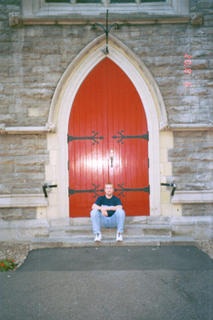
I am convinced that the problem with "the world" is not what those who do not know God do, but what those who do know God don't do. Rich Mullins once said, "What amazes me is that God did not come up with any plan B. The Church is it - it is God's hope for the world."
I do not think I am contrary to the verse out of 1st John when I write, "I love the world." I do - I love it. I am a huge fan of it, as well as the One who made it. No, I do not indulge in drugs. No, I am not sexually promiscuous. No, I have never been drunk. In fact, surprisingly, I have found that I am incorrupted by the detriments of the world even though I listen to music by unsaved songwriters, I go and see movies in which drugs are used, crimes are committed, and every once in a while, someone is nude for whatever reason. But, truthfully, I don't see these things. I see a story of determination and bravery, of waking up to the Beauty and wonder of life. I see flawed, hurting characters stumbling through their story, desperate for redemption. And I think to myself, "THIS is real life. THESE are the kind of people to whom I am called to show God's love. THIS is the world - the reality - in which I need to dwell." God knows the bubble is not succeeding in this.
Last night, in a conversation on this very subject, my friend, Grayson, remarked, "I wonder if it is such a bad thing to be 'desensitized.'" He went on to tell a Beautiful story about a short conversation, saturated in grace, that he had with one of the prostitutes that works on his street corner. "I told her 'hello' and asked her how she was and then I just said, 'You look great. You are so beautiful,'" Grayson recalls. "I don't know where that came from, but I know, in that moment, I absolutely meant it. ... I think that is exactly how Jesus saw people." I'm afraid those in the bubble would never be able to experience a grace-giving friendship with the prostitutes on 15th street - they would have moved out of that neighborhood at the first sign of worldliness.
Frederick Buechner writes, "Needless to say, church isn't the only place where the holy happens. Sacramental moments can occur at any moment, at any place, and to anybody. Watching something get born. Making love. A walk on the beach. Somebody coming to see you when you're sick. A meal with people you love. Looking into a stranger's eyes and finding out he's not a stranger. If we weren't as blind as bats, we might see that life itself is sacramental."
I'm new to this, and I do not claim to have just presented the best reflection on this subject. But I think of the book of Proverbs, where Wisdom calls from the streets, to the "naive" and the "fools." She cries for them to bend an ear to her and to come to her in the streets, for, to those who are not afraid to come, she offers understanding, righteousness, and knowledge. She offers herself. She offers the truth of God.
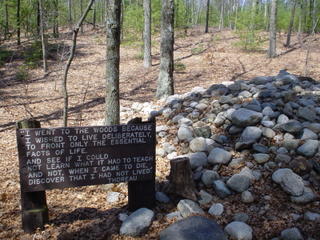
Amusing, yes. Confusing, absolutely. How could he not believe in that movie? Granted, it was a pretty outlandish plot, but the basic theme that tornados are destructive forces of nature that need to be better studied should have been completely understood by my father, who experienced this reality at full force. Yet, my father separated himself from not only the movie, but the discussion of such things.
American Christianity has formed its own sub-culture, and has defaulted to this same attitude that my father expressed when confronted with that Jan de Bont film. It is impossible for Christians in America today to not be aware of the progression of the culture in all its different directional tangents (this is often described as a "decline" by many in the Church). But, in their awareness, they have shrunk away like children from their father's cane. "Separation" or "isolation" are becoming more and more the fitting words to describe the Church in America.
I fell victim to this sub-culture, mainly because it is quite deceptive in that, from the outset, it comes across as scriptural. Two of the main passages from the Bible that are cited often to argue that Christians should keep the world at no less than arm's length are 1st John 2:15-17 and Philippians 4:8. And truth be told, the Bible does address the danger of immersing oneself in the world, of taking worldly ways upon oneself. Unfortunately for the sub-culture, never is there mentioned the words "separation" or "isolation." Yet, as a member of this sub-culture from high school through college, I followed the unwritten rules that included: not seeing movies that were R (or, if they were, could have no nudity or sexual references in them - apparently violence and foul language were not as bad); I only read books in the Christian publishing market; I did not support the sinfully promiscuous music industry by purchasing any "secular music;" and of course, weekends never included attendance in any bars, clubs, or questionable parties.
And so, around four years ago, I was crippled by the effects of a massive YAWN. I became so bored - so completely unlike anything I saw in society - that I felt not only very alone, but also extremely ineffective in sharing the love of Jesus Christ with anyone. While many do it everyday (entire children, youth, and college retreats are built around it every summer), I found that separating myself from everything in the world did not make me something special (someone God stood up and applauded) - it only made me excrutiatingly dull. If we were honest with ourselves - with our sinful condition, whether we are Christians or non - I think the idea of God applauding anything having to do with our willpower would be highly laughable. Let's face it, one of the main reasons Christ died is because our willpower to refrain from disobedience is practically non-existent.
But the argument remains, as does the tired youth group-ish question, "Are you "in" the world, "out" of the world, or "of" the world?" (If that confuses anyone, "of" is the bad answer.) And this argument, which is quite intricate and vitally important, I believe, to the future of the Church, boils down to one main thing: Fear. Christians who resign themselves to dwell within this sub-culture (to refrain from the extreme realities of the world, like the recognition of crime, alcohol, drug use, disease, promiscuity, sexual confusion, etc.) might not admit this, but it is not necessarily faithfulness to their clean & tidy God that keeps them in this bubble - it is fear of what exposure to what is outside the bubble might do to them, how it will compromise their purity, mount an assault on their salvation.
I was rescued from the sub-cultural bubble not by any person, so much as a love for good writing and good music and good story-telling, things of which the Christian sub-culture market has little. The first to go was my refusal to read books by non-Christian writers. Being an English major in college, I would have had a difficult time sticking to my guns on that one. In finally opening my mind to both classic and contemporary writers who do not cater to the Christian bubble (though I have found several who are very inspiring Christians), I discovered an exciting new world unfolding before me. But, oh, my reserved sub-culture spirit was sweating nervous bullets ... These days, the music I listen to and the movies I enjoy no longer meet the criteria of the bubble - they meet my own criteria.
Thanks to several in depth conversations that have taken place over the past four months (two big ones in the last three days, actually), I believe I can communicate this sufficiently, at least as far as I'm concerned:
There are two amazing realities in life that determine what I get involved / show interest in. Beauty and Redemption. This stems from my belief in the truth of Scripture, most specifically the Gospel of Christ. I believe God incarnated himself to reveal to humanity these two things. The Creator wanted to show humankind where Beauty could truly be found, and from whence it ultimately originated (in the Creator), and the Creator wanted to make humankind aware of the fact that they are all bent towards Redemption, that every person's "story" is one that is attempting (often struggling) to find redemption (which, according to Scripture, only finds ultimate fulfillment in the overarching, all-sufficient redemption of Jesus on the cross and out of the tomb). Jesus illustrated these two realities in many ways - parables, lessons, sermons, miracles, healings - but none so great as the way he simply spent the days of his life, constantly journeying and surrounding himself with the downtrodden, the dirty, and the despicable (those who, today, would without question dwell outside the bubble). I believe, without a doubt, that Jesus daily spoke of Redemption to them, as well as honestly saw them as Beautiful. He did not allow their degradation or their careless living or their constant rebellion to deter him from spending time with them, being the Light in their darkness.
We strive to be like Jesus, and we continually cite this truth that he hung out with the rejects of society as that which strikingly communicates the boundlessness of his love. But we cannot resemble this love or be like Jesus from our isolated position in the bubble. And because so many do not budge from the sub-culture, the sub-culture is despised (and we shrug this off and quote the scripture that Jesus said the world would hate us). In essence, we are afraid of the world.
I am convinced that the problem with "the world" is not what those who do not know God do, but what those who do know God don't do. Rich Mullins once said, "What amazes me is that God did not come up with any plan B. The Church is it - it is God's hope for the world."
I do not think I am contrary to the verse out of 1st John when I write, "I love the world." I do - I love it. I am a huge fan of it, as well as the One who made it. No, I do not indulge in drugs. No, I am not sexually promiscuous. No, I have never been drunk. In fact, surprisingly, I have found that I am incorrupted by the detriments of the world even though I listen to music by unsaved songwriters, I go and see movies in which drugs are used, crimes are committed, and every once in a while, someone is nude for whatever reason. But, truthfully, I don't see these things. I see a story of determination and bravery, of waking up to the Beauty and wonder of life. I see flawed, hurting characters stumbling through their story, desperate for redemption. And I think to myself, "THIS is real life. THESE are the kind of people to whom I am called to show God's love. THIS is the world - the reality - in which I need to dwell." God knows the bubble is not succeeding in this.
Last night, in a conversation on this very subject, my friend, Grayson, remarked, "I wonder if it is such a bad thing to be 'desensitized.'" He went on to tell a Beautiful story about a short conversation, saturated in grace, that he had with one of the prostitutes that works on his street corner. "I told her 'hello' and asked her how she was and then I just said, 'You look great. You are so beautiful,'" Grayson recalls. "I don't know where that came from, but I know, in that moment, I absolutely meant it. ... I think that is exactly how Jesus saw people." I'm afraid those in the bubble would never be able to experience a grace-giving friendship with the prostitutes on 15th street - they would have moved out of that neighborhood at the first sign of worldliness.
Frederick Buechner writes, "Needless to say, church isn't the only place where the holy happens. Sacramental moments can occur at any moment, at any place, and to anybody. Watching something get born. Making love. A walk on the beach. Somebody coming to see you when you're sick. A meal with people you love. Looking into a stranger's eyes and finding out he's not a stranger. If we weren't as blind as bats, we might see that life itself is sacramental."
I'm new to this, and I do not claim to have just presented the best reflection on this subject. But I think of the book of Proverbs, where Wisdom calls from the streets, to the "naive" and the "fools." She cries for them to bend an ear to her and to come to her in the streets, for, to those who are not afraid to come, she offers understanding, righteousness, and knowledge. She offers herself. She offers the truth of God.

Friday, June 10, 2005
Into the Silent Canyon - Part Three
In this, the last of my reflections on my excursion into the wilderness monastic community, I want to share the third and final pressing thing I observed while finding myself immersed in this Benedictine way of life. Though the consideration of such a subject has sparked a indeterminable weighty number of articles and books (books thicker than my waist many times, and I don't claim to have the thinnest of figures), I find my thoughts upon this subject during and since my time at the monastery have been rather simple - even short, which is not normal for such a long-winded person. To that end, this post will probably be the shortest of the three (but not by much), which will probably come as a relief to the few who actually read this blog.
This subject is the fullness of God.
I alluded to such a foundational element of the faith in my last post - that, and the lack of many Christians (within the American Church today) recognition of it. It became evident to me, in a kind of quietly revelatory manner, during my time in the canyon, that those "in" my particular style of faith (Baptist and more Free-church, evangelical culture denominations) are very Christ-centered in our faith and in our expression of our faith. This is not wrong. In fact, I truly believe it is of the greatest importance of both the individual Christian and the Church. For Christ is the Savior of every person on earth, past and present and future, as well as the head of the Church. This is not simply a Pauline doctrine. As I view it, it is basic Christology.
However (oh yes, there is a "however," for if not, there would be no real point to this post), I believe those "in" my tradition have, in their Christ-centered way of doing things, displaced two other important elements. That is, they have lost the necessary, equal importance of God the Father, and the Holy Spirit. Not very often will you hear, in my church tradition, a prayer addressed to the Spirit, nor will you hear much talk of God the Father without coupling him like a motorcycle sidecar to Jesus Christ. While I never rejected the importance of the central truth and devotion to Christ while I was worshipping with the monks in New Mexico, I came to cherish their complete recognition of the Trinity - the equality and shared deserving of our worship. Scripture speaks much in family metaphor, and though it does not explicitly speak of the Trinity (for it is a construction coming out of early Church history), the doctrine of the Trinity is grounded in the presence of the three persons of God revealed in the Bible. We are accepted as children of God, made brothers with Christ, and guided in an almost parental manner by the Spirit ("he will guide you into all truth ..." - John 16:13). Indeed, the Trinity seems to share familial ties, metaphorically speaking, though such is their binding and their oneness with one another that Yahweh God goes far beyond simple family metaphor. St. John of the Cross envisioned the persons of the Trinity in a kind of constant dance with each other - this was how they were bound - and indeed many times it seems God dances with his children ... sings over them ... fellowships with them in a hundred thousand different ways.
And yet rarely if ever in my church tradition do I hear equal importance, equal reverence, and equal submission being expressed of the Trinity. Our Christ-centeredness is not Christ-centeredness at all if we throw out the Father and/or the Spirit and focus our attention solely on Christ. He will stand stark, measurable, and without the blinding reality of his fullness. It is interesting to note the way in which salivating evangelicals defended Mel Gibson's The Passion of the Christ because of its "flawless" depiction of Christ's suffering. I will admit, I was greatly moved by the film - it is one of only a very small number of films I have viewed in my lifetime that have brought me to tears. However, upon emerging from the stunned silence of the theater, I could not help but think, "I understand completely why some Jewish people are upset by this film." For one, most of the Jews (true to Scripture or not) were indeed made to look evil for evil's sake - not much more developed than a James Bond villain. And secondly, coupled with the excrutiating amount of hype surrounding the film, everything became centered on Christ, and the basic feeling among many evangelicals was, Christ is God, bar none; any Jewish resentment is simply and sadly the grumblings of people who worship a pagan god. Oh, how wrong a sentiment that is! Jews worship the same God that we as Christians do, but there are many Christians who would shudder at this reality. This is because we have, over the decades and centuries, completely separated Christ and our "Christian God" from his very history, that which is immersed in and made knowable only through Jewish culture and writings.
The point is this: Christ is more than simply the patron saint of Christianity. He is not the end-all focus; he is central to our faith, but this is not the same thing. The Trinity is what surrounds us, watches over us, "speaks" to us, directs us, etc. Not simply Christ. We must seek to let our worship conform to the fullness of God - Yahweh God expressed in the Father, the Son, and the Holy Ghost - and not simply one part of him. The Apostles' Creed itself begins in this way. Christ is my Savior. He is my Lord. And he is both the human and divine expression of God for salvation and redemption. But he is the Son of my heavenly Father, and the aim of the Spirit which guides me in lifestyle and love.
As I mentioned in my previous post, at the close of almost every psalm chanted, as well as each hour of prayer, the guests and monks would always sing the doxology known as the "Glory Be." It is, "Glory be to the Father, and to the Son, and to the Holy Spirit. As it was in the beginning, is now and ever shall be. World without end. Amen." We would bow for these words, chanting them before the throne of God (Hebrews 4:16), our full and glorious God.
The Trinity - the fullness of God - is a difficult subject, and I do not assume to have even the slightest percentage of understanding on it. But there is one thing I do know, and it is a beautiful thing when I step aside and let it (and not me) drive my life into what it must desperately be. The Trinity is the people of this earth's best way of understanding a God who is infinitely beyond understanding, beyond our ability to nail him down and figure him out (despite what a thousand different Christian-market fiction and non-fiction books would have you believe). And somewhere within this mystery, we find him to be our Father, our Brother, our Guide, our Friend, our Lover, our Head, our Help, our Hope ...
Thank God for metaphor, huh?

Jesus in the Monastery Chapel
This subject is the fullness of God.
I alluded to such a foundational element of the faith in my last post - that, and the lack of many Christians (within the American Church today) recognition of it. It became evident to me, in a kind of quietly revelatory manner, during my time in the canyon, that those "in" my particular style of faith (Baptist and more Free-church, evangelical culture denominations) are very Christ-centered in our faith and in our expression of our faith. This is not wrong. In fact, I truly believe it is of the greatest importance of both the individual Christian and the Church. For Christ is the Savior of every person on earth, past and present and future, as well as the head of the Church. This is not simply a Pauline doctrine. As I view it, it is basic Christology.
However (oh yes, there is a "however," for if not, there would be no real point to this post), I believe those "in" my tradition have, in their Christ-centered way of doing things, displaced two other important elements. That is, they have lost the necessary, equal importance of God the Father, and the Holy Spirit. Not very often will you hear, in my church tradition, a prayer addressed to the Spirit, nor will you hear much talk of God the Father without coupling him like a motorcycle sidecar to Jesus Christ. While I never rejected the importance of the central truth and devotion to Christ while I was worshipping with the monks in New Mexico, I came to cherish their complete recognition of the Trinity - the equality and shared deserving of our worship. Scripture speaks much in family metaphor, and though it does not explicitly speak of the Trinity (for it is a construction coming out of early Church history), the doctrine of the Trinity is grounded in the presence of the three persons of God revealed in the Bible. We are accepted as children of God, made brothers with Christ, and guided in an almost parental manner by the Spirit ("he will guide you into all truth ..." - John 16:13). Indeed, the Trinity seems to share familial ties, metaphorically speaking, though such is their binding and their oneness with one another that Yahweh God goes far beyond simple family metaphor. St. John of the Cross envisioned the persons of the Trinity in a kind of constant dance with each other - this was how they were bound - and indeed many times it seems God dances with his children ... sings over them ... fellowships with them in a hundred thousand different ways.
And yet rarely if ever in my church tradition do I hear equal importance, equal reverence, and equal submission being expressed of the Trinity. Our Christ-centeredness is not Christ-centeredness at all if we throw out the Father and/or the Spirit and focus our attention solely on Christ. He will stand stark, measurable, and without the blinding reality of his fullness. It is interesting to note the way in which salivating evangelicals defended Mel Gibson's The Passion of the Christ because of its "flawless" depiction of Christ's suffering. I will admit, I was greatly moved by the film - it is one of only a very small number of films I have viewed in my lifetime that have brought me to tears. However, upon emerging from the stunned silence of the theater, I could not help but think, "I understand completely why some Jewish people are upset by this film." For one, most of the Jews (true to Scripture or not) were indeed made to look evil for evil's sake - not much more developed than a James Bond villain. And secondly, coupled with the excrutiating amount of hype surrounding the film, everything became centered on Christ, and the basic feeling among many evangelicals was, Christ is God, bar none; any Jewish resentment is simply and sadly the grumblings of people who worship a pagan god. Oh, how wrong a sentiment that is! Jews worship the same God that we as Christians do, but there are many Christians who would shudder at this reality. This is because we have, over the decades and centuries, completely separated Christ and our "Christian God" from his very history, that which is immersed in and made knowable only through Jewish culture and writings.
The point is this: Christ is more than simply the patron saint of Christianity. He is not the end-all focus; he is central to our faith, but this is not the same thing. The Trinity is what surrounds us, watches over us, "speaks" to us, directs us, etc. Not simply Christ. We must seek to let our worship conform to the fullness of God - Yahweh God expressed in the Father, the Son, and the Holy Ghost - and not simply one part of him. The Apostles' Creed itself begins in this way. Christ is my Savior. He is my Lord. And he is both the human and divine expression of God for salvation and redemption. But he is the Son of my heavenly Father, and the aim of the Spirit which guides me in lifestyle and love.
As I mentioned in my previous post, at the close of almost every psalm chanted, as well as each hour of prayer, the guests and monks would always sing the doxology known as the "Glory Be." It is, "Glory be to the Father, and to the Son, and to the Holy Spirit. As it was in the beginning, is now and ever shall be. World without end. Amen." We would bow for these words, chanting them before the throne of God (Hebrews 4:16), our full and glorious God.
The Trinity - the fullness of God - is a difficult subject, and I do not assume to have even the slightest percentage of understanding on it. But there is one thing I do know, and it is a beautiful thing when I step aside and let it (and not me) drive my life into what it must desperately be. The Trinity is the people of this earth's best way of understanding a God who is infinitely beyond understanding, beyond our ability to nail him down and figure him out (despite what a thousand different Christian-market fiction and non-fiction books would have you believe). And somewhere within this mystery, we find him to be our Father, our Brother, our Guide, our Friend, our Lover, our Head, our Help, our Hope ...
Thank God for metaphor, huh?

Jesus in the Monastery Chapel
(At days' end, the light of the setting sun would end up upon him.)
Friday, June 03, 2005
Into the Silent Canyon - Part Two
It has been about two weeks since I have returned from my excursion in the wilderness. But being in a canyon so far removed from the hustle and bustle of society is not something that is easily displaced in the mind. The memories are still very vivid, as I should hope they would be, and will be for quite a long time, at least until, God-willing, I can return to a place like that again.
In my last post, I wrote of silence, about my need for it, about the Church's need to rediscover it, about a need I believe dwells deep inside of all of us to seek it, let it manifest itself from the outside in (when possible) and from the inside out (hopefully achieved with time and practice). It is in the same vein that I write today, but concerning something else of imperative importance in both my life and the Church; it is a topic containing both similar and different implications. It is a second condition I observed in the canyon at the Monastery of Christ in the Desert.
Solemnity. The art or condition of being solemn. Such was everything that took place in that canyon, from four AM Vigils to stacking wood during the work hours, to eating lunch, to taking the time, as students, to study the assigned readings given to us by Dr. Gloer. From sunrise to sunset, there was a peace - a calmness unlike any I have experienced in recent memory - that pervaded every aspect of life at the monastery. There was never a rush, even in the few times I found myself treading quicker-than-usual up the dirt road in an effort to attend an hour of prayer on time. I realized from an early point during my stay in the canyon that this quality was one of the reasons why I initially felt so out-of-place, as if I was not a good fit to this place, even as a mere guest.
At every hour of prayer, the monks would enter, robed in whatever specific garb was considered appropriate to the hour, in no rush to begin, nor with any desire to pass the moments leading up to prayer by shooting the breeze with their fellow monks or the guests. Silence settled upon the chapel like a falling veil. What was utmost in importance during these moments was the condition of the heart, and the manner in which each person prepared himself to come before Almighty God. The monks would pad softly in, kneel obediently to what I called "the Bureau," which was a large chest that contained the elements of the Eucharist, and then bow humbly to the altar as they made their way to their chairs. Likewise, as we, the guests, entered, we bowed respectfully to the altar and took our seats; once seated, I found it worthwhile to focus on clearing my various thoughts and concerns in some way or another, as if allowing my mind and heart to take their own deep, calming breaths, preparing my whole self for worship. Out of such deliberate action, I found a greater recognition of reverence for God before, during, and after the times of prayer, and it seemed I was able to comprehend, at a stronger level, the specific psalms, hymns, and prayers being chanted to God.
I don't believe it can be denied that everything we do in worship is, in essence, prayer to God. It is all communication, on both individual and communal levels - at least, it should be considered in this way. Unfortunately, I notice a disease pervading much of the American Church, and that is this habit of structuring worship like a production, or a concert, or a self-help seminar, or any manner of programs not fully and simply devoted to communing with the God of creation, the God of us. When I visit my hometown church, I find many things distracting about it, and I am not just referring to their gaudy, electronic sign out front that makes them look like a bank or a very exquisite gas station. I mean no disrespect to my hometown church, but, while attending the Sunday morning worship service, I am puzzled at the presence of six vocalists flanking the music minister as he leads the choruses and hymns. What in the world are they doing up there? Are they suppose to be assisting the worship leader, or just helping him guide me through the songs? Because I must say, I am not in need of any assistance, let alone six extra singers, nor do I think is the music minister. Instead, they look uncomfortably to me like an overpopulated vocal group minus the choreography (though I've heard of some churches that aren't missing the choreography) and without the "brooding, sexy" group member. The stage (which seems to get bigger and bigger the more a church grows) has replaced the altar, and in so doing the church service has become more and more like a concert from some vocally uncoordinated pop group. We are production-oriented people these days, and I believe the Church is in a bad way because of it. It is hard to gaze out at the massive wave of technology and cultural progressiveness and not view it as a welcomed addition to what many times feels like stale worship. However, I fear that this wave is more of a tsunami (and not in the exciting way Leonard Sweet, the Emergent Church representative describes it) that will cause more destruction than we suspect. It already has.
Please do not misunderstand my feelings about progressive culture and the American Church. I am pleased with much of what we can do these days, with video, audio, ect. I believe there are many ways to accentuate worship - to make it more relevant to the culture. However, I believe many of us, in an attempt to do this, are running so excitedly ahead that we have become like Wile E. Coyote spinning his wheel-like feet out into nothingness - we have found ourselves set up for a fall. Some of us have not noticed yet - some of us have. Some of us have already plummeted, our heads remaining suspended in the air, only recently realizing what went wrong.
I give the concert description as simply an example of the condition of the church today. There are many other elements that have lost their central purpose, their captivating point. What matters is that all speak to a greater problem - that is, the loss of solemnity in worship. We have misplaced the mystery; we have lost the mysticism. This is a problem parallel with many of us in our individual life as Christians. Our worship is decadent and gluttonous. We desire the newest bible study, the latest praise song, the most extravagant musical arrangement or sleekest worship band riff. The largest congregation, the most successful mission trips, the most exciting youth/children's camp, the most technologically advanced building. The most relevant staff. The most impacting preacher.
Some people, in many different ways, both subtle and blatant, have accused me of being a snob of sorts on this topic. Because I'm a seminary student currently emersed in the study of church history, specifically that of worship traditions, I obviously loath the advancements of our modern culture. Such is not the case. I believe there is a worthwhile goodness in each of these desires I have listed; there is nothing wrong with any of them, to an extent. The problem is, many of us in the Church want all these things, but rarely do we add to this list the simple reality of the presence of Christ. In fact, I suspect that if many of us were honest with ourselves - truly, deeply honest - we would not trade these desires for Christ. God alone is rarely, if ever, exciting, and being production-oriented, excitement-driven people, the simple presence of Christ just is not going to fill our need - or so we believe.
The simple presence of Christ, however, is truly all we need. The experience of God in his fullness - the love and guidance of the Father, Son, and Holy Ghost. It will fill us up in ways that the greatest combination of all these other spiritual desires will leave only stark emptiness. In the last post, I encouraged us to turn off all the noise in our lives long enough to realize the wonder of a God who speaks to us in sheer silence. I believe we must put aside all the rushed glitz and glamour that we have welcomed into our churches in the name and hope of relevance and progressivism. It is extremely important to structure our services toward cultural relevance, but not at the expense of the age-old need of communion with God. To be solemn before the Almighty, to be quiet and reverent, is what he requires of us.
At the end of almost every psalm and prayer we prayed at the monastery, we would chant a doxology: "Glory be to the Father, and to the Son, and to the Holy Spirit. As it was in the beginning, is now and ever shall be. World without end. Amen." Everytime we said this, we would once again bow to the altar, which signified the sacrifice of Christ. At this moment, heads and torsos bent to the floor, everything and everyone else was blocked out. Our recognition was only of the holy God.
And it was enough. It was more than enough.

Inside the chapel at the Monastery of Christ in the Desert
The altar (representing the sacrifice of Christ) is in the foreground, and the bureau-like cabinet, containing the elements of the Eucharist (representing the presence of Christ), is directly behind it.
Sacrifice and offering you did not desire, but my ears you have opened; burnt offerings and sin offerings you did not require. Then I said, "Here I am, I have come - it is written about me in the scroll. I desire to do your will, O my God; your law is within my heart." - Psalm 40:6-8
Monday, May 30, 2005
Into the Silent Canyon - Part One
The thirteen-mile, winding, deep-rutted dirt road that leads off the New Mexico highway into the the National Forest causes many a traveler to nervously gulp air. Prayers are whispered before one even rumbles up to the guesthouse of the Monastery of Christ in the Desert, the small Benedictine monastery set deep within the Chama River canyon. We arrived just after the sun bid its farewell behind the high western mountains across the river, and because the guesthouse does not have electricity, I and my classmates had to unpack and prepare our rooms in dim lamplight. But what greeted us most stunningly as we stumbled and staggered out of the fifteen passenger van (which, we were quite thankful, our assistant dean, Rene, had been able to navigate along a road that at times curves treacherously 200 feet above rushing rapids of the Chama River) was the utter silence of the place. Besides crickets, the faint trickle of the river, and the occasional warble of a nocturnal bird, there was nothing. No highway noise, no cacophonous chatter of human voices, no buzz or hum of creature-comfort appliances. This was the wilderness - we were immediately greeted by its spirit, and with hardly any prodding, we conformed to this nature. Our mouths closed; we blended into the silent night.
It is of such a silence that I write about on the blog in the first of my posts about this extraordinary trip. I have remained silent in my apartment before, as well as in my car, and at school, and even, if I'm feeling "centered" enough, at church. However, I have never experienced a silence like the silence in which I was washed at the monastery. Silence before this trip was merely the absence of sound, of me making noise. If we try hard enough, we can all achieve an atmosphere of this brand of silence. But this is the runt cousin of the silence I encountered in the Chama River canyon. This silence was not merely absence of sound. This was a silence that was alive. Behind the fullness of quiet, I could sense a presence. I recognize how sentimental and slightly dramatic that might read, but I am not making this up for the sake of spinning this post with a devotional flair. There was truly, to me, a noticeable presence behind the silence. I could not help but think back to the story of Elijah from which I posted an excerpt in the post I wrote before departing on the trip. Within the sheer silence Elijah encountered on the mountain, all ragged, downcast with fear, and covered in his mantle, there was the unmistakable presence of God.
I am not one of the people you often meet who say, "Well, today I was praying, and God told me this ..." or "I went hiking the other day and had a vision of God ..." or "I know that Jesus is telling me to do this ..." I have always been wary of attributing the ideas in my head, the drives to say or do something, to God. I have never heard God speak audibly. Some people claim they have - still others (who I assume are secretly insecure of their own faith) adamantly state that you aren't a real person of faith unless you have heard God speak to you audibly, or Jesus, or the Spirit, or whatever is their favorite character of the Trinity. I don't know if I ever will hear God speak audibly. I believe our ears and our eyes play more tricks on us sometimes than does our heart, and so the inaudible is perhaps a safer level on which God would communicate with us. I believe God speaks - or better yet, God reveals - his desires for us and for the world, on a much deeper level. And I'll be honest, I have yet to know exactly when this communication takes place, though I suspect it is happening in some slowly constant way, 99% of the time when I am not paying attention at all.
What is the point? Two things: 1) Being in the silent canyon at the monastery revealed to me the truth of the old saying, "Silence is golden." It is awkward at first, sure, to step out of our loud lives into silent worship, but once the initial shock wears off, the peace and tranquility found within it is the stuff of matchless wonder. Our normal activities, especially within our churches today, are so very tragically rushed, and often loud for the sake of attention-grabbing. We kick the beat of praise choruses with roto-tom fills and vociferous beats of a base drum, we attempt to double and triple-strum our guitars to make our worship songs more lavish, if only to keep worship energetic, engaging. Oh, if we would only seek the opposite - to be silent before our holy God. I believe we will recognize more of what he is tellings us when we come stripped down, empty, listening instead of broadcasting. 2) I am addicted to noise. It is a sick addiction, like anything else really. There are moments, like my time at the monastery, where I catch a glimpse of the peace and the calm that can be experienced when I quiet myself, when I chuck what I think is a need to constantly feed myself with noise, be it television, radio, conversation, or talking to myself, which is something I have begun to notice I do often. Perhaps I should consider a fast for my ears - a noise fast.
I do not know how to experience that living, breathing, speaking silence I encountered in the canyon, but I believe the presence I felt there is the same presence that is settled over me now, whether I choose to recognize it - trust that it is there - or not.
There is more to that deep silence than we realize. I understand that now. We have bought into the lie that silence is merely a sign that we should seek some noise to fill the void. We have wrongly allowed the world we live in to condition our bodies and minds to feel discomfort - even dread - when we encounter silence. Instead, the next time we find ourselves awash in the soft nothingness of quiet, let us not hug our trembling shoulders nervously, but open wide our arms to embrace the Maker of silence, for in it he often chooses to dwell.

The Wilderness Spirituality class in front of the chapel
It is of such a silence that I write about on the blog in the first of my posts about this extraordinary trip. I have remained silent in my apartment before, as well as in my car, and at school, and even, if I'm feeling "centered" enough, at church. However, I have never experienced a silence like the silence in which I was washed at the monastery. Silence before this trip was merely the absence of sound, of me making noise. If we try hard enough, we can all achieve an atmosphere of this brand of silence. But this is the runt cousin of the silence I encountered in the Chama River canyon. This silence was not merely absence of sound. This was a silence that was alive. Behind the fullness of quiet, I could sense a presence. I recognize how sentimental and slightly dramatic that might read, but I am not making this up for the sake of spinning this post with a devotional flair. There was truly, to me, a noticeable presence behind the silence. I could not help but think back to the story of Elijah from which I posted an excerpt in the post I wrote before departing on the trip. Within the sheer silence Elijah encountered on the mountain, all ragged, downcast with fear, and covered in his mantle, there was the unmistakable presence of God.
I am not one of the people you often meet who say, "Well, today I was praying, and God told me this ..." or "I went hiking the other day and had a vision of God ..." or "I know that Jesus is telling me to do this ..." I have always been wary of attributing the ideas in my head, the drives to say or do something, to God. I have never heard God speak audibly. Some people claim they have - still others (who I assume are secretly insecure of their own faith) adamantly state that you aren't a real person of faith unless you have heard God speak to you audibly, or Jesus, or the Spirit, or whatever is their favorite character of the Trinity. I don't know if I ever will hear God speak audibly. I believe our ears and our eyes play more tricks on us sometimes than does our heart, and so the inaudible is perhaps a safer level on which God would communicate with us. I believe God speaks - or better yet, God reveals - his desires for us and for the world, on a much deeper level. And I'll be honest, I have yet to know exactly when this communication takes place, though I suspect it is happening in some slowly constant way, 99% of the time when I am not paying attention at all.
What is the point? Two things: 1) Being in the silent canyon at the monastery revealed to me the truth of the old saying, "Silence is golden." It is awkward at first, sure, to step out of our loud lives into silent worship, but once the initial shock wears off, the peace and tranquility found within it is the stuff of matchless wonder. Our normal activities, especially within our churches today, are so very tragically rushed, and often loud for the sake of attention-grabbing. We kick the beat of praise choruses with roto-tom fills and vociferous beats of a base drum, we attempt to double and triple-strum our guitars to make our worship songs more lavish, if only to keep worship energetic, engaging. Oh, if we would only seek the opposite - to be silent before our holy God. I believe we will recognize more of what he is tellings us when we come stripped down, empty, listening instead of broadcasting. 2) I am addicted to noise. It is a sick addiction, like anything else really. There are moments, like my time at the monastery, where I catch a glimpse of the peace and the calm that can be experienced when I quiet myself, when I chuck what I think is a need to constantly feed myself with noise, be it television, radio, conversation, or talking to myself, which is something I have begun to notice I do often. Perhaps I should consider a fast for my ears - a noise fast.
I do not know how to experience that living, breathing, speaking silence I encountered in the canyon, but I believe the presence I felt there is the same presence that is settled over me now, whether I choose to recognize it - trust that it is there - or not.
There is more to that deep silence than we realize. I understand that now. We have bought into the lie that silence is merely a sign that we should seek some noise to fill the void. We have wrongly allowed the world we live in to condition our bodies and minds to feel discomfort - even dread - when we encounter silence. Instead, the next time we find ourselves awash in the soft nothingness of quiet, let us not hug our trembling shoulders nervously, but open wide our arms to embrace the Maker of silence, for in it he often chooses to dwell.
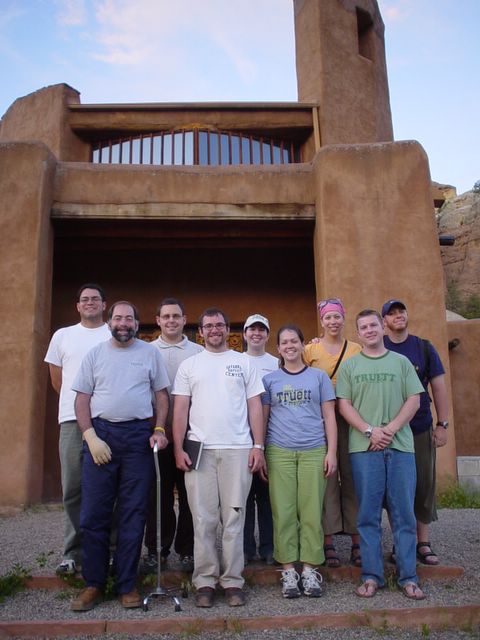
The Wilderness Spirituality class in front of the chapel
(back: Rene, Kyle, Leslie, Jill, Brandon, front: Dr. Gloer, Jeff, Courtney, Vernon)
* This is the first of several posted reflections on my experience at Christ in the Desert Monastery.
Check back soon for new entries, as well as more pictures.
Saturday, May 14, 2005

Subscribe to:
Posts (Atom)


