For a long time now, I have been reading a lot of blogs that contrast good churches vs. bad churches, and/or address the symptoms and evidence of what constitutes a dead or dying church. There is so much written in cyberspace about this subject it would not surprise me if I found out the subject dwelt within its own sort of cyber-subculture ... and I would place money that such a network would be pessimistic in tone and outlook.
To be a part of a church or mega-church that is more concerned with image or status quo safety, or to look around and see the many churches and "Christian organizations" that seem to have this following-Jesus thing all wrong, is indeed a frustrating thing. We want to see change. Some of us want to incite that change. Many others want to discuss that change. Unfortunately, few of us actually desire to work toward that change, and to dig into the work so completely that we shut up about the problem long enough to involve ourselves in the fix.
I realize by writing this entry, I immediately align myself with one of the former groups. However, I've decided that if I'm going to write about this subject, I might as well be as honest as I can...
The thing that frustrates me even more than dead or dying churches are the many people who label such churches this way. Call them cynical, or pessimistic, or just judgmentally sardonic, but rarely are these people apt to give a particular struggling church or mega-church a chance if an alternative congregation/community is, in their opinion, getting it right where the others are getting it so wrong. Whether the alternative community is emergent, relevant, innovative, or all of the above, to a person who has learned how to judge the Church, it is simply one thing: greener pastures. In essence, it is the congregational equivalent of a white flight. A neighborhood changes in outlook or becomes too crowded, invaded by people different from me, and I look to the suburbs outside of town where it is safer and I like the look of the landscape a lot better, where people think like me and don't mind my condemnation of the old neighborhood because, instead of staying there to enact change, they escaped to the greener pastures as well. The more I apply this metaphor, the more I see the new, hip, alternative congregations as the greener pastures, and the old model churches (or, even sometimes, the mega-churches) as the old neighborhood many of us are leaving behind for the cause of returning Jesus, and true Christianity, to the Church.
How do we justify planting new congregations if we abandon old ones to do so? If there is a place with a "need," fine. But if the need is just to plant a church that isn't as frustrating or backward, I'm not as quick to appreciate the plant. Did anyone try to affect change in the old community first? Or were they just too close-minded, too set in their ways?
I realize some of what I'm writing here is biting into my own thoughts and behavior, but I read so much subtle (and sometimes non-subtle) condemnation of the mega-church Christian subculture, and rarely, if ever, read of the dangers of escaping these churches that might have some things - if not many things - wrong with it.
My church is one that many of the blogs I read would label as dead or dying. Our attendance is down, as many people are leaving as are visiting, we are consolidating bible studies and Sunday classes because we don't have enough of any one age or station in life to meet on their own. There are people in our church that see missions as nothing more than giving money, and we are involved in very few direct outreach programs to the community. All in all, for many people in my church, life on Sunday morning is lived much different than life during the week. Such criteria is the fodder for these blogs, and it screams, "Abandon this church and find yourself a relevant community that is making an impact!" And a part of me would love to, but then, whether like a loyal captain or Lot's wife, I look back and think, "What will become of them if I, too, leave them behind?" Do I just cut and run and leave them to die? Do I do nothing ... when I certainly could do something ... anything ... EVERYTHING I can to try and save the church?
Maybe this entry is simply the squeaking voice of a person too scared to abandon a sinking Titanic unaware of the certain death that awaits ... or maybe it is of a person who is not ready to give up on a community of people who might have a lot of it wrong, but is still a community with blood running through its veins, with a life that can still be seized and lived toward impact. I do not agree that a dying church is not worth saving. I do not even believe that a dead church (containing whatever criteria makes them that in your opinion) is not worth saving. My church may not be relevant right now, but we're working on it. Who knows whether we'll get there, but there's more to serving God than simply correcting our motivations.
Showing posts with label Cynicism - The Sneering Monster. Show all posts
Showing posts with label Cynicism - The Sneering Monster. Show all posts
Tuesday, July 17, 2007


Thursday, March 08, 2007
Leaving the Runway
Last night, I spoke with some of the youth at the church about "The Lost Tomb of Jesus," the docu-drama that has created an incessantly annoying buzz in the worlds between the media and academia, especially archaeological, scriptural, and theological studies. To read more about this ridiculous documentary, go here, or here, or, for more scholarly information and links, go here.
What was interesting to me is what has been going on inside me, in my mind and my spirit, while I debate and refute this documentary and the claims it makes. I explained last night to the youth that when stuff like this pops up in the news and culture, Christians will normally react in three different ways. 1) They will spiral into a pissed-off realm of reactivity and begin lambasting Hollywood, Jews, skeptics, science, and whatever and whomever else they feel has done the cultural and media equivalent of stalking down the aisles of our churches and slapping our pastor in the face. 2) They will become increasingly paranoid, whether because they worry that something discovered might shatter their faith, or that their weak faith won't be able to stand up to the pressure that some discovery, valid or not, will do when it invokes its own defendants hungry for a debate of the facts. 3) They will embrace the dialogue, excited for the chance that some people will take themselves and their religious interest serious enough for a while in which a calm, collected Christian might be able to persuade them to tweak their worldview to include faith in a mystery.
Inside, while I'm explaining all this, I feel uneasy, because I suspect I am undulating somewhat between the latter two. I feel as if I am bouncing back and forth sometimes. It is hard not to be paranoid. Belief built on faith and not proof has a tendency, at times, to cause trepidation in a person if someone claims to have proof to the contrary. As much as I believe this whole "discovery" is, in reality, completely incorrect in what its proponents are claiming it is, I still cannot shake some of the residual paranoia that finds its way into my bones, and, uniting with my love of dialogue and debate, threatens to make me like the first kind of Christians mentioned above.
Why is it so difficult to leave behind this desire for proof? Why does faith in the mystery sometimes feel like a burden rather than a blessing? The ambiguity of the gospels, the selectivity of the New Testament writers, the odd faith of it all, can be hard to maintain at times, and even harder to live convincingly before those who feel that they need more, who feel that they need proof.
As I spoke with some of the confused youth last night (that seems to be a pattern most Wednesdays, that I leave some of them more confused than when they came in), I tried to illustrate the purpose of faith beyond proof to them, as it is central to the Christian life. "It's like a plane taxiing down a runway," I explained. "The runway is proof. It's grounded. It's solid. It's sure. You're almost certainly safe on the runway. But, if you're going to get from here to your true destination- if your faith in God is going to fly - then, eventually, you have to take off. You have to leave the solidity of the ground for the freedom, and hopeful uncertainty, of the wide open sky. Otherwise, you'll just taxi around in circles and never get anywhere."
If we are to fly, the proof must fade into hope. In both is faith, but the goal of faith is found somewhere on the other side of the horizon.
What was interesting to me is what has been going on inside me, in my mind and my spirit, while I debate and refute this documentary and the claims it makes. I explained last night to the youth that when stuff like this pops up in the news and culture, Christians will normally react in three different ways. 1) They will spiral into a pissed-off realm of reactivity and begin lambasting Hollywood, Jews, skeptics, science, and whatever and whomever else they feel has done the cultural and media equivalent of stalking down the aisles of our churches and slapping our pastor in the face. 2) They will become increasingly paranoid, whether because they worry that something discovered might shatter their faith, or that their weak faith won't be able to stand up to the pressure that some discovery, valid or not, will do when it invokes its own defendants hungry for a debate of the facts. 3) They will embrace the dialogue, excited for the chance that some people will take themselves and their religious interest serious enough for a while in which a calm, collected Christian might be able to persuade them to tweak their worldview to include faith in a mystery.
Inside, while I'm explaining all this, I feel uneasy, because I suspect I am undulating somewhat between the latter two. I feel as if I am bouncing back and forth sometimes. It is hard not to be paranoid. Belief built on faith and not proof has a tendency, at times, to cause trepidation in a person if someone claims to have proof to the contrary. As much as I believe this whole "discovery" is, in reality, completely incorrect in what its proponents are claiming it is, I still cannot shake some of the residual paranoia that finds its way into my bones, and, uniting with my love of dialogue and debate, threatens to make me like the first kind of Christians mentioned above.
Why is it so difficult to leave behind this desire for proof? Why does faith in the mystery sometimes feel like a burden rather than a blessing? The ambiguity of the gospels, the selectivity of the New Testament writers, the odd faith of it all, can be hard to maintain at times, and even harder to live convincingly before those who feel that they need more, who feel that they need proof.
As I spoke with some of the confused youth last night (that seems to be a pattern most Wednesdays, that I leave some of them more confused than when they came in), I tried to illustrate the purpose of faith beyond proof to them, as it is central to the Christian life. "It's like a plane taxiing down a runway," I explained. "The runway is proof. It's grounded. It's solid. It's sure. You're almost certainly safe on the runway. But, if you're going to get from here to your true destination- if your faith in God is going to fly - then, eventually, you have to take off. You have to leave the solidity of the ground for the freedom, and hopeful uncertainty, of the wide open sky. Otherwise, you'll just taxi around in circles and never get anywhere."
If we are to fly, the proof must fade into hope. In both is faith, but the goal of faith is found somewhere on the other side of the horizon.
Friday, February 16, 2007
Observations from the Couch
It appears that I am down for the count this weekend. My throat is raw, scratchy, sore, and, to use the appropriate medical term, "just plain icky." My olfactory is filled with all manner of things it should not normally house. I'm drinking orange juice and putting my faith in the not-so-miraculous powers of Sudafed, Benadryl, and Ricola. I need to sleep, but I find it hard to sleep in the middle of the day no matter how exhausted I am, unless it is Sunday (for some reason, I can sack out on Sunday after church like a grizzly bear beginning its hibernation).
So, in the meantime, I am posting the response from the Focus on the Family offices to my - how shall I describe it? - letter of complaint. I wasn't sure if they would respond, and the fact that they did rather promptly brings me to a bit more respect for them than I had of late. However, I'm not so sure that the basic point of my letter was received, because the woman's defense seems like a standard one - almost a faxed in response. After reading so many of these magazines, something I have realized is that my concept of what can motivate "godly behavior" does not have to be something devoid of darkness, pain, or angst, whereas their opinion is that something in pop culture cannot serve as a godliness motivator if it doesn't almost explicitly proclaim black and white biblical truth. I've written on this dilemma before - to read more, go here.
Still, it is encouraging to know we are both seeking to help students, even if we completely disagree on how it should be done.
___________
Letter of response:
Thank you, Bo, for contacting Plugged In.
We appreciate your taking the time to share your concerns regarding the reviews in our publication. In response, it’s important to understand that Plugged In is not written for teens, pre-teens, or young adults, but rather for *parents* who need help sorting out their kids’ entertainment choices. You might be surprised at the number of Christian parents who haven’t a clue as to what their children are encountering “out there” on a daily basis. Plugged In seeks to lay it all out for them as dispassionately as possible. This is why our writers go to great lengths to identify every aspect of a film, television show, or CD, even down to the smallest detail, that might possibly constitute a problem for concerned moms and dads. Once parents have the facts, they can make wise, discerning decisions of their own with regard to their families’ entertainment options.
In addition, it would be impossible to discern whether movies, TV shows, or music are positive or negative – helpful or harmful – without making value-based decisions, or judgments. In fact, a large part of “learning to discern” is evaluating whether the actions portrayed or the words presented motivate us toward godly behavior, or toward actions that are sinful. As our statement of faith and guiding principles explain, Focus on the Family’s values regarding family life, sexual morality, music, movies, and other issues are grounded in the teachings of the Bible rather than the changing opinions of contemporary society. Please be assured that we do not wish to condemn or alienate those who disagree with biblical principles. However, in our efforts to reach out and minister, we cannot compromise our beliefs or change the direction of our ministry simply to accommodate differing views.
Again, thank you for expressing your opinions so honestly. God’s grace and peace to you in the days ahead.
Amy Campbell
PluggedInOnline.com
So, in the meantime, I am posting the response from the Focus on the Family offices to my - how shall I describe it? - letter of complaint. I wasn't sure if they would respond, and the fact that they did rather promptly brings me to a bit more respect for them than I had of late. However, I'm not so sure that the basic point of my letter was received, because the woman's defense seems like a standard one - almost a faxed in response. After reading so many of these magazines, something I have realized is that my concept of what can motivate "godly behavior" does not have to be something devoid of darkness, pain, or angst, whereas their opinion is that something in pop culture cannot serve as a godliness motivator if it doesn't almost explicitly proclaim black and white biblical truth. I've written on this dilemma before - to read more, go here.
Still, it is encouraging to know we are both seeking to help students, even if we completely disagree on how it should be done.
___________
Letter of response:
Thank you, Bo, for contacting Plugged In.
We appreciate your taking the time to share your concerns regarding the reviews in our publication. In response, it’s important to understand that Plugged In is not written for teens, pre-teens, or young adults, but rather for *parents* who need help sorting out their kids’ entertainment choices. You might be surprised at the number of Christian parents who haven’t a clue as to what their children are encountering “out there” on a daily basis. Plugged In seeks to lay it all out for them as dispassionately as possible. This is why our writers go to great lengths to identify every aspect of a film, television show, or CD, even down to the smallest detail, that might possibly constitute a problem for concerned moms and dads. Once parents have the facts, they can make wise, discerning decisions of their own with regard to their families’ entertainment options.
In addition, it would be impossible to discern whether movies, TV shows, or music are positive or negative – helpful or harmful – without making value-based decisions, or judgments. In fact, a large part of “learning to discern” is evaluating whether the actions portrayed or the words presented motivate us toward godly behavior, or toward actions that are sinful. As our statement of faith and guiding principles explain, Focus on the Family’s values regarding family life, sexual morality, music, movies, and other issues are grounded in the teachings of the Bible rather than the changing opinions of contemporary society. Please be assured that we do not wish to condemn or alienate those who disagree with biblical principles. However, in our efforts to reach out and minister, we cannot compromise our beliefs or change the direction of our ministry simply to accommodate differing views.
Again, thank you for expressing your opinions so honestly. God’s grace and peace to you in the days ahead.
Amy Campbell
PluggedInOnline.com
Thursday, February 08, 2007
The Tale of the Wearied Defense Attorney
As a few of you have noticed (if you still check this blog, which has been stagnant for a month), I took a leave of absence from blogging. Wedding plans kicked in at high gear and have not slowed down, and that, along with coordinating the next six months of student ministry at the church, have kept my fingers from the keys and my mouse cursor from the PUBLISH button. However, I do find some time to get some thoughts down, and I figured I would share some of that until I can get back to my normal routine on here.
The following is an e-mail letter I wrote to a magazine called Plugged In, which is published monthly by Focus on the Family as a resource for parents, ministers, and teens. It claims to review pop culture in a "Christian" light. The more I peruse the publication, the more I loathe their close-minded reviews. Perhaps I am just cynical, but in case you would like to get a taste for yourself, visit their online version here. The reviews of Aaron Sorkin's work did not necessarily push me over the edge into writing a letter, but I did choose to use the reviews as an example, since their opinions of The West Wing and Studio 60 on the Sunset Strip I could not have found less objective.
Dear Plugged In:
As the student minister at my church, working with middle school, high school, and college students, I am growing extremely weary of standing between two opposing sides who are becoming, whether they claim to be or not, increasingly hostile toward each other. It is getting more and more difficult to serve solely as an ambassador of Christ, as Scripture calls all Christians to do. Lately I feel instead like a defense attorney for American conservative Christianity. The backbiting, name-calling, and exclusivist attitudes of our "Christian culture" are creating rifts between the Church and young people of this country and it is only getting worse. This magazine is a prime example. How? Because you uphold only that which is white-washed and pristine, and any piece of pop culture that contains a noticeable shred of darkness, disagreement, confusion, or angst, you lambaste as being that which is leading the youth of America astray. Take, for instance, your Nov. 2006 review of the engagingly intelligent and entertaining NBC show, Studio 60 on the Sunset Strip. You may argue a fairness of writing style, but the article's tone is most certainly biased against the show. Anyone who closely watches Studio 60 (as all reviewers should) will recognize that the Christian character, Harriet Hayes, is never humiliated for the values she upholds, nor do the characters who disagree with her find their views and ideologies triumphing hers. The show is simply not about jabbing back at evangelical America. Quite the contrary, it is a picture of how different views clash and function together in a very real entertainment environment - an environment that plays before the eyes of people, young and old, day after day. Why must everything that does not wave a Christian flag proudly and claim allegiance to the "morals" of Scripture be written off as inappropriate for viewers - even teenage viewers? Do we actually believe that we are helping our young people adapt to this ever-changing society by shielding them from every little piece of rebellion and unchristian view? We are so afraid any kind of exposure might shatter them as if they are made of glass.
In reality, pop culture does not have to be the enemy, even when pieces of it might contain lostness and rebellion. Scripture is certainly not without darkness, sin, and confusion. You knock The West Wing's President Bartlett for wrestling with God to the point of cursing him, but would praise many of the psalms that do pretty much the same thing. I would rather show that particular West Wing episode to my youth group than any number of Christianized films with cookie-cutter storylines and lame moments of conversion devoid of any real human pain and struggle. Why? Because the former is real! It is tangible; an image that does not make living the Christian life, or believing in God, or seeking to do the right thing, seem like an easy option.
Still, our Christian culture piles up more and more sterilized alternatives that are declared uplifting and edifying for followers of Christ, and those who do not buy into this candy-coated fluff are seen as desensitized compromisers, rather than what they are, believers who are unafraid of the culture, and ready to walk confidently into the buzzing mainstream. Christians who can locate Truth even in dark places, places not empty of all crudeness and pain. Christians who wholeheartedly agree with the words of Madeleine L'Engle, that "there is nothing so secular that it cannot be made sacred, and that is one of the deepest messages of the Incarnation." At first, I thought this is what Plugged In was about, but over the years I see little in your magazine that does not uphold this cultural Christian battle-line.
And so I feel like a wearied defense attorney. Constantly wishing my client would just settle down and shut up, I struggle to save Christianity from so many of its close-minded followers, while I seek to present its deep Truth, that of fallenness, pain, confusion, mercy, grace, beauty, laughter, and an ultimate redemption.
Please don't be so quick to neatly divide light and darkness, the good from the bad. Look deeper. For the sake of this culture and the young people who will inherit it, look deeper.
The following is an e-mail letter I wrote to a magazine called Plugged In, which is published monthly by Focus on the Family as a resource for parents, ministers, and teens. It claims to review pop culture in a "Christian" light. The more I peruse the publication, the more I loathe their close-minded reviews. Perhaps I am just cynical, but in case you would like to get a taste for yourself, visit their online version here. The reviews of Aaron Sorkin's work did not necessarily push me over the edge into writing a letter, but I did choose to use the reviews as an example, since their opinions of The West Wing and Studio 60 on the Sunset Strip I could not have found less objective.
Dear Plugged In:
As the student minister at my church, working with middle school, high school, and college students, I am growing extremely weary of standing between two opposing sides who are becoming, whether they claim to be or not, increasingly hostile toward each other. It is getting more and more difficult to serve solely as an ambassador of Christ, as Scripture calls all Christians to do. Lately I feel instead like a defense attorney for American conservative Christianity. The backbiting, name-calling, and exclusivist attitudes of our "Christian culture" are creating rifts between the Church and young people of this country and it is only getting worse. This magazine is a prime example. How? Because you uphold only that which is white-washed and pristine, and any piece of pop culture that contains a noticeable shred of darkness, disagreement, confusion, or angst, you lambaste as being that which is leading the youth of America astray. Take, for instance, your Nov. 2006 review of the engagingly intelligent and entertaining NBC show, Studio 60 on the Sunset Strip. You may argue a fairness of writing style, but the article's tone is most certainly biased against the show. Anyone who closely watches Studio 60 (as all reviewers should) will recognize that the Christian character, Harriet Hayes, is never humiliated for the values she upholds, nor do the characters who disagree with her find their views and ideologies triumphing hers. The show is simply not about jabbing back at evangelical America. Quite the contrary, it is a picture of how different views clash and function together in a very real entertainment environment - an environment that plays before the eyes of people, young and old, day after day. Why must everything that does not wave a Christian flag proudly and claim allegiance to the "morals" of Scripture be written off as inappropriate for viewers - even teenage viewers? Do we actually believe that we are helping our young people adapt to this ever-changing society by shielding them from every little piece of rebellion and unchristian view? We are so afraid any kind of exposure might shatter them as if they are made of glass.
In reality, pop culture does not have to be the enemy, even when pieces of it might contain lostness and rebellion. Scripture is certainly not without darkness, sin, and confusion. You knock The West Wing's President Bartlett for wrestling with God to the point of cursing him, but would praise many of the psalms that do pretty much the same thing. I would rather show that particular West Wing episode to my youth group than any number of Christianized films with cookie-cutter storylines and lame moments of conversion devoid of any real human pain and struggle. Why? Because the former is real! It is tangible; an image that does not make living the Christian life, or believing in God, or seeking to do the right thing, seem like an easy option.
Still, our Christian culture piles up more and more sterilized alternatives that are declared uplifting and edifying for followers of Christ, and those who do not buy into this candy-coated fluff are seen as desensitized compromisers, rather than what they are, believers who are unafraid of the culture, and ready to walk confidently into the buzzing mainstream. Christians who can locate Truth even in dark places, places not empty of all crudeness and pain. Christians who wholeheartedly agree with the words of Madeleine L'Engle, that "there is nothing so secular that it cannot be made sacred, and that is one of the deepest messages of the Incarnation." At first, I thought this is what Plugged In was about, but over the years I see little in your magazine that does not uphold this cultural Christian battle-line.
And so I feel like a wearied defense attorney. Constantly wishing my client would just settle down and shut up, I struggle to save Christianity from so many of its close-minded followers, while I seek to present its deep Truth, that of fallenness, pain, confusion, mercy, grace, beauty, laughter, and an ultimate redemption.
Please don't be so quick to neatly divide light and darkness, the good from the bad. Look deeper. For the sake of this culture and the young people who will inherit it, look deeper.
Monday, September 25, 2006
Of Jesus Camps, Dixie Chicks, Jerry Falwell, and the Pope
Lately, I have been stopped by the observation of how often Christians (and sometimes it is more accurate to place that title in quotation marks) misspeak, and cause mild to massive uproars. If it is not Pat Robertson and his misguided, bigotry-is-the-new-devotion attitude, then it is Pope Benedict XVI reading a point-of-view that probably could as well have been foregone. It is wearying that much of "mainstream Christianity" expression (which, sadly, is what most of what the secular world views as what Christianity is all cracked up to be) is spent either inserting or attempting to extract the proverbial foot from the mouth.
The latest, besides the Pope's pseudo-innocent blunder which enraged Muslims around the world, includes Jerry Falwell stating, in so many words, at a "Voter Value Summit" prayer breakfast, that Hillary Clinton would be worse for the U.S. as a president than Lucifer himself. Nice one, Jerry. Chalk up yet another point to your illustrious foot-in-mouth record.
As much as these incidents make me want to write, in bold letters, STOP SPEAKING FOR CHRISTIANS EVERYWHERE, YOU CLOSE-MINDED MORONS, AND LEARN TO SHUT UP AND SERVE PEOPLE, I have realized something even further: misspeaking is not reserved to media-friendly Christians, and looking like an idiot can come in a variety of ways. Take the Dixie Chicks, who are still trying to ride the wave of publicity that came from their anti-Bush, anti-Republican, anti-war comments in Great Britain some time ago (there is more I could write here, but a good friend has dealt with their lunacy already, and his thoughts are quite good). Or Bill O'Reilly, who makes idiotic statements just about every night. And Howard Dean doesn't fair much better. Mel Gibson, Danish cartoonists, Germaine Greer, Tom Cruise ... the list goes on and on and on.
But it seems "Christians" have a talent all our own when it comes to hating and claiming the things of this world. A new documentary is heading to theaters (it might even achieve a wide release) called Jesus Camp. Get ready for a storm of protests and praises, most of which will be misguided, I suspect. And then there is The Nativity Story, almost certain to be an assault on the mystery and innocent beauty of Advent, yet will probably become evangelicals' next lovechild (especially now that the high from The Passion of the Christ has worn off and Mel Gibson has moved from savior to bigot according to the media). Where and when will it end? And where do we, as Christians who are even afraid to claim that title anymore, run for refuge in a world that has forgotten humble, loving service of others for mass media proclamation and proselytization?
I have but one hope. It is that somewhere beneath all the noise and misspeak and bigotry and the claiming and pillaging of loyalties, there is a thread of peace and compassion and selflessness that runs steady through it all. In a world where too many churches have become dens of robbers, there might still be a community, however disjointed and disconnected, that seeks to be a "house of prayer." Amidst the chaos, there is a quiet hope that only a few of us might hear.
"Here on the New Jersey shoreline, in the greed and the glitter of those hi-tech casinos, some mendicants wander off to a cathedral, and they stoop in the silence and there their prayers are still whispered..." - Rich Mullins
"Enter through the narrow gate, for broad is the gate and wide is the road that leads to destruction, and many enter through it, but small is the gate and narrow the road that leads to life, and only a few find it." - Matthew 7:13-14
The latest, besides the Pope's pseudo-innocent blunder which enraged Muslims around the world, includes Jerry Falwell stating, in so many words, at a "Voter Value Summit" prayer breakfast, that Hillary Clinton would be worse for the U.S. as a president than Lucifer himself. Nice one, Jerry. Chalk up yet another point to your illustrious foot-in-mouth record.
As much as these incidents make me want to write, in bold letters, STOP SPEAKING FOR CHRISTIANS EVERYWHERE, YOU CLOSE-MINDED MORONS, AND LEARN TO SHUT UP AND SERVE PEOPLE, I have realized something even further: misspeaking is not reserved to media-friendly Christians, and looking like an idiot can come in a variety of ways. Take the Dixie Chicks, who are still trying to ride the wave of publicity that came from their anti-Bush, anti-Republican, anti-war comments in Great Britain some time ago (there is more I could write here, but a good friend has dealt with their lunacy already, and his thoughts are quite good). Or Bill O'Reilly, who makes idiotic statements just about every night. And Howard Dean doesn't fair much better. Mel Gibson, Danish cartoonists, Germaine Greer, Tom Cruise ... the list goes on and on and on.
But it seems "Christians" have a talent all our own when it comes to hating and claiming the things of this world. A new documentary is heading to theaters (it might even achieve a wide release) called Jesus Camp. Get ready for a storm of protests and praises, most of which will be misguided, I suspect. And then there is The Nativity Story, almost certain to be an assault on the mystery and innocent beauty of Advent, yet will probably become evangelicals' next lovechild (especially now that the high from The Passion of the Christ has worn off and Mel Gibson has moved from savior to bigot according to the media). Where and when will it end? And where do we, as Christians who are even afraid to claim that title anymore, run for refuge in a world that has forgotten humble, loving service of others for mass media proclamation and proselytization?
I have but one hope. It is that somewhere beneath all the noise and misspeak and bigotry and the claiming and pillaging of loyalties, there is a thread of peace and compassion and selflessness that runs steady through it all. In a world where too many churches have become dens of robbers, there might still be a community, however disjointed and disconnected, that seeks to be a "house of prayer." Amidst the chaos, there is a quiet hope that only a few of us might hear.
"Here on the New Jersey shoreline, in the greed and the glitter of those hi-tech casinos, some mendicants wander off to a cathedral, and they stoop in the silence and there their prayers are still whispered..." - Rich Mullins
"Enter through the narrow gate, for broad is the gate and wide is the road that leads to destruction, and many enter through it, but small is the gate and narrow the road that leads to life, and only a few find it." - Matthew 7:13-14
Thursday, September 21, 2006
The Substance of Things Hoped For
When did confidence become synonymous with faith? At what point did a a person's belief in God hinge on how much he or she took at face value, and how little was questioned? Such a question has become almost like a riddle to me these days, as if the answer might come like a punchline, and I would have to nod, scratch my head, and mumble, "Ohhh..." when falls the answer.
As I have shared in earlier posts regarding my own journey in and through faith, I was once taught that Hebrews 11:1, "Now faith is being sure of what he hope for and certain of what we do not see," could be translated by injecting the word "certain" in place of "hope," thus rendering the verse, "Now faith is being certain of what we are certain of and certain of what we do not see." In other words, with faith there are no questions, because if one is certain, one needs not seek clarification.
As is often the case, the NIV sits somewhere between a good translation and a bad one. The NASB works well, especially in the use of the word "conviction." And, as is often the case, the Contemporary English and Holman Christian Standard versions fail miserably in capturing the mystic nature and weight of this single verse. To test most of the translations, go here and have a ball.
It is the King James Version that wins the gold ribbon in my opinion. It reads, "Now faith is the substance of things hoped for, the evidence of things not seen." Many who read this might shrug and mutter, "What's the difference?" Perhaps I am nit-picking diction, but this version of the verse frees me rather than binds me. I do not mean to imply that I'm trying to manipulate Scripture so that I might have it read the way I want it to. On the contrary, I mean only to rescue Scripture from a Western thought-process that seeks facts over story, definition over mystery.
In our society, in our culture, we desire answers. We want results. We need proof. We bank on reasons. This is a remarkably different mindset than the days of the Old Testament, and even the days of Jesus, where Hellenistic (Greek) culture was already washing across much of the civilized world. Mystery was accepted in OT time. Not all things needed proof. The facts of a story were not nearly as important as the story itself. This is why there is so much vengeance, lament, doubt, and challenging of God in the Psalms and the Prophets. People were not expected to shut up and take everything with no questions, no concerns, no emotion exhaled. Apologists will point to the reason for the forbidden tree in Eden being that God did not want humans to be puppets and therefore blessed us with free choice, but then they will try to boil the movement and existence of God down to provable facts. What kind of freedom of belief is that? I've got news for them (and all of us): it does not, and will never, work that way.
God dwells in mystery, and he does not condemn us when we do not understand, when we doubt, and when we question. He wants us to wrestle with him - why else would he stalk Jacob in the wilderness? He boomed at Job, not for his questions, but because his questions had left the realm of doubt and moved on into despair. And, in the end, that is what the opposite of faith is - despair. Not doubt.
So, let me wrestle with my God. Let me collide with him. Let me question his ways, and seek to understand the sobering truth: that I will never fully understand him. On the other side of these things lies the substance of things hoped for, true faith.
As I have shared in earlier posts regarding my own journey in and through faith, I was once taught that Hebrews 11:1, "Now faith is being sure of what he hope for and certain of what we do not see," could be translated by injecting the word "certain" in place of "hope," thus rendering the verse, "Now faith is being certain of what we are certain of and certain of what we do not see." In other words, with faith there are no questions, because if one is certain, one needs not seek clarification.
As is often the case, the NIV sits somewhere between a good translation and a bad one. The NASB works well, especially in the use of the word "conviction." And, as is often the case, the Contemporary English and Holman Christian Standard versions fail miserably in capturing the mystic nature and weight of this single verse. To test most of the translations, go here and have a ball.
It is the King James Version that wins the gold ribbon in my opinion. It reads, "Now faith is the substance of things hoped for, the evidence of things not seen." Many who read this might shrug and mutter, "What's the difference?" Perhaps I am nit-picking diction, but this version of the verse frees me rather than binds me. I do not mean to imply that I'm trying to manipulate Scripture so that I might have it read the way I want it to. On the contrary, I mean only to rescue Scripture from a Western thought-process that seeks facts over story, definition over mystery.
In our society, in our culture, we desire answers. We want results. We need proof. We bank on reasons. This is a remarkably different mindset than the days of the Old Testament, and even the days of Jesus, where Hellenistic (Greek) culture was already washing across much of the civilized world. Mystery was accepted in OT time. Not all things needed proof. The facts of a story were not nearly as important as the story itself. This is why there is so much vengeance, lament, doubt, and challenging of God in the Psalms and the Prophets. People were not expected to shut up and take everything with no questions, no concerns, no emotion exhaled. Apologists will point to the reason for the forbidden tree in Eden being that God did not want humans to be puppets and therefore blessed us with free choice, but then they will try to boil the movement and existence of God down to provable facts. What kind of freedom of belief is that? I've got news for them (and all of us): it does not, and will never, work that way.
God dwells in mystery, and he does not condemn us when we do not understand, when we doubt, and when we question. He wants us to wrestle with him - why else would he stalk Jacob in the wilderness? He boomed at Job, not for his questions, but because his questions had left the realm of doubt and moved on into despair. And, in the end, that is what the opposite of faith is - despair. Not doubt.
So, let me wrestle with my God. Let me collide with him. Let me question his ways, and seek to understand the sobering truth: that I will never fully understand him. On the other side of these things lies the substance of things hoped for, true faith.
Monday, July 17, 2006
Eating My Tail
I want to revisit the second topic of consternation from my last post. Cynicism. Truth be known, I'm starting to realize that much of my exploration into the cynical side of me somehow flows out of just that, my cynicism, rather than a pure conscience. Such a pietic, prideful bias on things not only feeds the sometimes necessary yet often unnecessary critique of life and worship, but also the desire to pick and scratch and brush at the very base attitudes from which such observations spring. It's like that Asian iconic image of a serpentine dragon cast in a circle, eating its own tail, a perfectly destructive cycle.
I am beginning to recognize that there is little that my critique, alone, can accomplish, especially regarding my own worship life or the mission and purpose of the Church. The frustrating thing about all this is that critique is pretty much all I can give these days, especially since I am still jobless. But even if I was serving on a church staff somewhere, I doubt I would have much more to offer than simply criticism. I often find it hard to move past recognizing what should be done, and actually doing what should be done. I think most of us do. What is more, those that can find a way past words and into action often do so stumbling, their efforts misguided by their resolve. One of the most extreme examples is Communism, which is the tragically misguided result of what might have very originally been a good-hearted seed of critique.
Thomas Merton writes - struggles - with this concept in the pages of his autobiography, The Seven Storey Mountain. He is lost somewhere between wanting to enact a change, and figuring out just how to do it. And in that hazy middle are the listless people that do nothing, and the zealous people who do everything ... wrong.
I have been accused of being quite cynical at times when I am not trying to be. (Sometimes I am merely trying to be funny, as was the case yesterday in church when, following the service, I tried to joke with my friend that the frivolous tune "Mercy is Falling" sounds silly rather than worshipful when the entire congregation sings the meaningless words "Hey-Oh" several times during the chorus. "You might as well replace 'Hey-Oh' with 'Boo-Yah!'," I remarked, getting few laughs but several mildly-offended expressions.) Other times I have spoken quite cynically and illicited no response. And there are the few and far between times when I have made a judgment, whether spoken graciously or not, and received an agreement that carried the conversation deeper. However, in all three scenarios, I can later lament that nothing significant - certainly no change - was achieved.
There is only one thing I continue to return to (and sadly, I continually reject) that seems the only thing worthwhile to effect change in both the sad state of things as well as my cynicism. Perhaps the reason I reject it so often is because it seems so intangible. So syrupy. So Care Bear-ish.
Love.
The love of one person that beckons his or her neighbors into a deeper relationship, and, inevitably, a change. The love of a boy for his girlfriend. The love of a parent for his or her son or daughter. The love of God that transforms us all.
It seems invariably true that cynicism pervades more of me than I realize. It is not limited to my worship life and my thoughts and feelings about the Church and ministry. I find my overgrown pride contaminating many things, often times in surprising, backdoor ways. My relationships with friends, parents, my girlfriend; it is even in my thoughts when I am in solitude. Like the dragon, I am indeed eating myself.
And then there is Scripture, and once again, this love, this glorious, sacramental concept of Love, seems the only cure.
Therefore, as God's chosen people, holy and dearly Loved, clothe yourselves with compassion, kindness, humility, gentleness and patience. Bear with each other and forgive whatever grievances you may have against one another. Forgive as the Lord forgave you. And over all these virtues put on Love, which binds them all together in perfect unity. Colossians 3:12-14
The metaphor is simply that of dressing. Put on Love. It does not seem like doing so is initiating much action, but I am starting see that there is a difference between taking action and taking reaction. The latter can become more problematic than the original problem.
Put on Love. There really is not much more that can be said.
As a matter of fact, there isn't anything at all.
I am beginning to recognize that there is little that my critique, alone, can accomplish, especially regarding my own worship life or the mission and purpose of the Church. The frustrating thing about all this is that critique is pretty much all I can give these days, especially since I am still jobless. But even if I was serving on a church staff somewhere, I doubt I would have much more to offer than simply criticism. I often find it hard to move past recognizing what should be done, and actually doing what should be done. I think most of us do. What is more, those that can find a way past words and into action often do so stumbling, their efforts misguided by their resolve. One of the most extreme examples is Communism, which is the tragically misguided result of what might have very originally been a good-hearted seed of critique.
Thomas Merton writes - struggles - with this concept in the pages of his autobiography, The Seven Storey Mountain. He is lost somewhere between wanting to enact a change, and figuring out just how to do it. And in that hazy middle are the listless people that do nothing, and the zealous people who do everything ... wrong.
I have been accused of being quite cynical at times when I am not trying to be. (Sometimes I am merely trying to be funny, as was the case yesterday in church when, following the service, I tried to joke with my friend that the frivolous tune "Mercy is Falling" sounds silly rather than worshipful when the entire congregation sings the meaningless words "Hey-Oh" several times during the chorus. "You might as well replace 'Hey-Oh' with 'Boo-Yah!'," I remarked, getting few laughs but several mildly-offended expressions.) Other times I have spoken quite cynically and illicited no response. And there are the few and far between times when I have made a judgment, whether spoken graciously or not, and received an agreement that carried the conversation deeper. However, in all three scenarios, I can later lament that nothing significant - certainly no change - was achieved.
There is only one thing I continue to return to (and sadly, I continually reject) that seems the only thing worthwhile to effect change in both the sad state of things as well as my cynicism. Perhaps the reason I reject it so often is because it seems so intangible. So syrupy. So Care Bear-ish.
Love.
The love of one person that beckons his or her neighbors into a deeper relationship, and, inevitably, a change. The love of a boy for his girlfriend. The love of a parent for his or her son or daughter. The love of God that transforms us all.
It seems invariably true that cynicism pervades more of me than I realize. It is not limited to my worship life and my thoughts and feelings about the Church and ministry. I find my overgrown pride contaminating many things, often times in surprising, backdoor ways. My relationships with friends, parents, my girlfriend; it is even in my thoughts when I am in solitude. Like the dragon, I am indeed eating myself.
And then there is Scripture, and once again, this love, this glorious, sacramental concept of Love, seems the only cure.
Therefore, as God's chosen people, holy and dearly Loved, clothe yourselves with compassion, kindness, humility, gentleness and patience. Bear with each other and forgive whatever grievances you may have against one another. Forgive as the Lord forgave you. And over all these virtues put on Love, which binds them all together in perfect unity. Colossians 3:12-14
The metaphor is simply that of dressing. Put on Love. It does not seem like doing so is initiating much action, but I am starting see that there is a difference between taking action and taking reaction. The latter can become more problematic than the original problem.
Put on Love. There really is not much more that can be said.
As a matter of fact, there isn't anything at all.
Friday, June 09, 2006
Three Short Tales of Consternation
It has been a long, long time since I have posted. Rest assured, faithful readers (all three of you), I am not giving up on the activity of blogging. On the contrary, here on this blog is where I find the freedom to express, even if just to myself, the deepest wonderings of my mind. Unfortunately, the frequent movement and relocation in my life of late has made it nearly impossible to sit down and do just that, express. Thankfully, I sit now in a coffee shop in West Houston, with simply a few moments to sit, think, and share but a few glimpses of my life over the past few months, and the ponderings that such experiences summon forth.
________
Consternation #1: The Job Search
Simply stated, it has not gone well. I struggle to find the place, but have been afforded fewer interviews than fingers on my right hand. Such failure dredges up a desire in me to want to react against the American church, Baptists and other specific denominations, and Truett Seminary itself. Many churches that I feel very qualified for reject me without so much as a phone call or a questionairre via e-mail, leaving me to wonder if it is because I am affiliated with Truett and the CBF, or because I am not yet ordained (though I hope to be eventually, when I find the right community in which to undergo the process). Other churches flatly turn me down for even an initial interview based on the flimsy excuse that I have no larger church experience. When I inquire how one obtains larger church experience, they all say I must work on a larger church staff. They have no real answer to my subsequent question: how do I work on a larger church staff when no larger church staff will hire me because I have not yet worked on a larger church staff?
I have fallen into some brief spells of depression, anger, and tearful sorrow, as it seems the search is wearing very thin, time is running out, and it appears I may have to do the one thing I do not want to do - teach high school. But I always assumed there would be a church, there would be a position. I suppose there is still much naivity in me.
Some people incredulously rebuke me for my frustration because they say I am not being open to God's leading. They tell me that looking only in the greater Houston area is limiting God's providence. I am not sure how I feel about that. I believe that God has led me to Leigh, the love of my life, and that he has a plan for me in the Houston area. Calvinism and Armenianism notwithstanding, I don't believe I can thwart the plans of God. However, my present circumstances seem more in favor of those who tell me that I can.
_______
Consternation #2: Negative, Cynical Me
I am a cynical person. I do not blame Truett for making me this, but I do recognize that it was not until I came through seminary that I began examining the Church in a much more serious, careful light. This has caused me to reject a lot of shallowness that I see in the Church, especially in evangelical circles, specifically in the area of worship. I can become very negative about some churches and their services, but I am even more negative toward myself. I hate how cynical I am, and how much humility I lack.
This past Sunday, I attended Grace Bible Church in Houston with Leigh and her sister. This is a two-year old church that presently gathers in a large movie theater downtown (a stone's throw from Lakewood); it is an "off-shoot" of Second Baptist Church in Houston. I could not worship in this place ... and I promise that I tried. I simply could not. All the songs were led by a band in typical (almost "traditional" these days) praise and worship style. All the songs were popular ones: God of Wonders, Here is Our King, Beautiful One, King Eternal, Unchanging, etc. Now, there is nothing inherently wrong with these songs. In fact, they are all good, and I have sung whole-heartedly to each one in the past, but when they are played the exact same way, back to back to back, and separated by quick prayers (all similar), a quick offering and then a sermon (another long one, timing out at around 40 minutes, which is better than last Tuesday's Austin Metro service, where the speaker preached five sermons in one over the course of an hour and fifteen minutes), forgive me, but I think something is missing.
Is this the future of the American evangelical church? Have we shredded eras of worship heritage, and created a much more succinct patchwork of liturgy, free of anything resembling ritual, meditation, beauty? As I said to Leigh, "I need more." I do not want to change Grace Bible Church, but I certainly would not want to worship there. For some people, P&W songs and a long, conversational sermon is all they need. For some people, that is worship. Not for me. I must have more.
There is no right way.
And one of the curses of going to seminary is that, whenever you share your opinion on such things, you are immediately (if not before the question) seen as either a snob or a cynical jerk. "Oh, you just say that because you went to seminary and you think you know everything about how it should be." I thought studying such things in seminary would help me speak to the condition of the church, but, ironically, because I studied such things my opinion is not desired. We fear change, I suppose. I fear change.
The long and the short of it is, I am wrong. I am cynical. I am not humble. Grace Bible Church is more right than I am. But even this understanding does not help the restlessness I feel with the present state of worship in the modern Church, and it doesn't keep me from despising myself for my attitude.
-----
Consternation #3: The Subtle Drift
Last night, Leigh, her sister, and I went to see Superman Returns (see farther below on sidebar for my grade). At one point, Lois (Kate Bosworth) and the Man of Steel (Brandon Routh) lift off into the sky on a romantic flight high over Metropolis. It is a tender moment, and whether or not it is a bit boring to watch means nothing regarding this observation. Lois, remembering her earlier days of gliding through the atmosphere with Superman, remarks as she draws closer to him, "I forgot how warm you are."
Almost the entire audience snickered. It was a suppressed, devious laugh exactly like the way one laughs at a sexual innuendo or misspoken euphemism. Granted, the line can indeed be taken two ways, but why does every one these days take the statement as "dirty." Why do our minds immediately call up something "naughty" rather than the memory of a comfortable, warm embrace. I believe that is what the line was originally meant to accomplish. I guess it should have been placed in a movie twenty years ago or so. Such a line is only crass comedy today, amidst America's subtle drift into perversion. Hmm, I sound like a fundamentalist ... Maybe I am.
But, if so, why aren't more churches interested in hiring me?
____
Images From the Last Two Months
 May Truett grads who did it in three years!
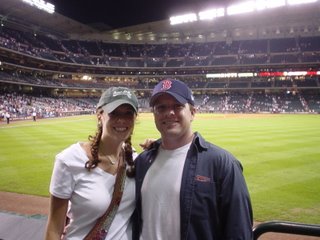 Leigh and I at the Houston Astros vs. Texas Rangers game
 My dogs, Gracie and Molly, sleeping where they're not supposed to be...
 My mother with her Kindergarten class. She retired this past May after over 20 years teaching...
 Being Happy
________
Consternation #1: The Job Search
Simply stated, it has not gone well. I struggle to find the place, but have been afforded fewer interviews than fingers on my right hand. Such failure dredges up a desire in me to want to react against the American church, Baptists and other specific denominations, and Truett Seminary itself. Many churches that I feel very qualified for reject me without so much as a phone call or a questionairre via e-mail, leaving me to wonder if it is because I am affiliated with Truett and the CBF, or because I am not yet ordained (though I hope to be eventually, when I find the right community in which to undergo the process). Other churches flatly turn me down for even an initial interview based on the flimsy excuse that I have no larger church experience. When I inquire how one obtains larger church experience, they all say I must work on a larger church staff. They have no real answer to my subsequent question: how do I work on a larger church staff when no larger church staff will hire me because I have not yet worked on a larger church staff?
I have fallen into some brief spells of depression, anger, and tearful sorrow, as it seems the search is wearing very thin, time is running out, and it appears I may have to do the one thing I do not want to do - teach high school. But I always assumed there would be a church, there would be a position. I suppose there is still much naivity in me.
Some people incredulously rebuke me for my frustration because they say I am not being open to God's leading. They tell me that looking only in the greater Houston area is limiting God's providence. I am not sure how I feel about that. I believe that God has led me to Leigh, the love of my life, and that he has a plan for me in the Houston area. Calvinism and Armenianism notwithstanding, I don't believe I can thwart the plans of God. However, my present circumstances seem more in favor of those who tell me that I can.
_______
Consternation #2: Negative, Cynical Me
I am a cynical person. I do not blame Truett for making me this, but I do recognize that it was not until I came through seminary that I began examining the Church in a much more serious, careful light. This has caused me to reject a lot of shallowness that I see in the Church, especially in evangelical circles, specifically in the area of worship. I can become very negative about some churches and their services, but I am even more negative toward myself. I hate how cynical I am, and how much humility I lack.
This past Sunday, I attended Grace Bible Church in Houston with Leigh and her sister. This is a two-year old church that presently gathers in a large movie theater downtown (a stone's throw from Lakewood); it is an "off-shoot" of Second Baptist Church in Houston. I could not worship in this place ... and I promise that I tried. I simply could not. All the songs were led by a band in typical (almost "traditional" these days) praise and worship style. All the songs were popular ones: God of Wonders, Here is Our King, Beautiful One, King Eternal, Unchanging, etc. Now, there is nothing inherently wrong with these songs. In fact, they are all good, and I have sung whole-heartedly to each one in the past, but when they are played the exact same way, back to back to back, and separated by quick prayers (all similar), a quick offering and then a sermon (another long one, timing out at around 40 minutes, which is better than last Tuesday's Austin Metro service, where the speaker preached five sermons in one over the course of an hour and fifteen minutes), forgive me, but I think something is missing.
Is this the future of the American evangelical church? Have we shredded eras of worship heritage, and created a much more succinct patchwork of liturgy, free of anything resembling ritual, meditation, beauty? As I said to Leigh, "I need more." I do not want to change Grace Bible Church, but I certainly would not want to worship there. For some people, P&W songs and a long, conversational sermon is all they need. For some people, that is worship. Not for me. I must have more.
There is no right way.
And one of the curses of going to seminary is that, whenever you share your opinion on such things, you are immediately (if not before the question) seen as either a snob or a cynical jerk. "Oh, you just say that because you went to seminary and you think you know everything about how it should be." I thought studying such things in seminary would help me speak to the condition of the church, but, ironically, because I studied such things my opinion is not desired. We fear change, I suppose. I fear change.
The long and the short of it is, I am wrong. I am cynical. I am not humble. Grace Bible Church is more right than I am. But even this understanding does not help the restlessness I feel with the present state of worship in the modern Church, and it doesn't keep me from despising myself for my attitude.
-----
Consternation #3: The Subtle Drift
Last night, Leigh, her sister, and I went to see Superman Returns (see farther below on sidebar for my grade). At one point, Lois (Kate Bosworth) and the Man of Steel (Brandon Routh) lift off into the sky on a romantic flight high over Metropolis. It is a tender moment, and whether or not it is a bit boring to watch means nothing regarding this observation. Lois, remembering her earlier days of gliding through the atmosphere with Superman, remarks as she draws closer to him, "I forgot how warm you are."
Almost the entire audience snickered. It was a suppressed, devious laugh exactly like the way one laughs at a sexual innuendo or misspoken euphemism. Granted, the line can indeed be taken two ways, but why does every one these days take the statement as "dirty." Why do our minds immediately call up something "naughty" rather than the memory of a comfortable, warm embrace. I believe that is what the line was originally meant to accomplish. I guess it should have been placed in a movie twenty years ago or so. Such a line is only crass comedy today, amidst America's subtle drift into perversion. Hmm, I sound like a fundamentalist ... Maybe I am.
But, if so, why aren't more churches interested in hiring me?
____
Images From the Last Two Months
 May Truett grads who did it in three years!
 Leigh and I at the Houston Astros vs. Texas Rangers game
 My dogs, Gracie and Molly, sleeping where they're not supposed to be...
 My mother with her Kindergarten class. She retired this past May after over 20 years teaching...
 Being Happy
Friday, March 10, 2006
A Call to Be Quiet
At my church's lectionary breakfast today, choral director Kurt Kaiser analogized the shallowness of many a church-goer's faith with music (a metaphor he is apt to employ with any number of issues). He called them "praise & worship Christians," and by this he was referring to what he views as one of the most significant problems (even dangers) of praise & worship music - it lacks depth. Depth of theology, depth of spirituality, depth of devotion, depth of purpose. Why not? Well, there has not been any significant demand for anything deeper from the majority of the Christian sub-culture. While this lack of depth does not include every praise & worship song or artist, the point is that too many people today sing "I'm coming back to the heart of worship, and it's all about you, it's all about you, Jesus..." when, deep down (or should I write "shallow down"), their hearts are actually singing, "I'm coming back to the heart of worship, and it's all about me, it's all about me, Jesus..."
In truth, I believe more and more Christians lack depth in their walk. I have often heard the assumption that most Christians live in the faith according to their "spiritual age" in the same way humans naturally live this life by their physical age. In other words, if I became a Christian at age eight, I am technically an eighteen year old in my faith. A late teenager, rebellious, yet seeking more depth - perhaps that is the core reason for this post.
There are two problems with this view. First, it plays against the recognition of salvation as continual and ongoing, something John Wesley alluded to as a understanding of "was saved, am being saved, shall be saved," which I believe is a much more healthy way of viewing such a weighty concept as eternal salvation. Secondly, it pigeonholes Christians into one simple, developmental structure, and anyone who pays attention to their growth (or stagnation) in the faith can tell you they don't mature at the same rate or in the same way as everyone else. We are snowflakes marked by Christ.
The truth is, if one were to hold to the age assumption, most Christians might adhere to it for a while, but by spiritual-age fifteen, they would most likely stop changing. Why? Because Christians tend to plateau, to stagnate. When it comes time to go deeper, we clutch the life-preserver and tread water rather than take the plunge. The writer of the first letter to the Corinthians mentioned such a problem when he wrote that the congregation was not ready for the deeper mysteries of the faith, that they were still in need of "spiritual milk."
For a very long time, I was secretly frustrated with the whole pop-Christian game that so many people, I truly believe, are caught up in. It is a lifestyle with a low ceiling, and while it does not discourage growth, it certainly doesn't encourage it either. In place of seeking deeper truth, it cranks the volume of the worship set a few decibels louder. I used to sing and sing for a deeper connection with God. I tried to pray longer and more white-knuckled, squinched-eye prayers to him. I watched people raise their hands freely in worship services, and others fall to their knees seemingly involuntarily, and I thought, If I could just be that free, that open, that unashamed, I would get to that deeper relationship. I was always told the answer was being faithful to the same old "quiet time" day after day. Nothing worked for me. And I became disillusioned, then self-berating, then more disillusioned.
It is only lately, in the past year of life, that I have begun to suspect a better way - perhaps the best way - to journey deeper in the faith. It is in the quiet - the contemplative. The things to which monks, missionaries, and all the Desert Fathers gave themselves. And the greatest truths we have in our rich heritage of devotional history have come not from epiphanies achieved in energetic, deafening worship services with Media Shout flickering and amped guitars squealing, but from mendicants who waited in silence and meditation for God to speak. For many to even begin to understand the mysteries of God, it took years upon years. But he spoke. When they finally quieted themselves, God spoke.

Suddenly, it seems, texts that call for clanging symbols and blaring trumpets become outnumbered by those texts we rarely take as seriously, such as "Be still and know that I am God..." and "In repentance and rest is your salvation, in quietness and confidence is your strength." When Elijah hid in the mountain, Yahweh's presence came not in a resounding crash or blaze, but only in "a sound of sheer silence."
As many evenings as possible this semester, I have been taking time to drive out to the Waco dam, sit on the concrete wall looking west, and enjoy the sunset. It is quiet. It is glorious. And often I am more awed by its forming than anything I read or sing all week.
Contemplation. Quiet. The absence of noise - even harmonious, catchy noise. If you find yourself as unfulfilled as I was, you might give it a try, and join me at this greater depth. I don't often involuntarily raise my hands, but I'm finding my head is bowed much more often.
In truth, I believe more and more Christians lack depth in their walk. I have often heard the assumption that most Christians live in the faith according to their "spiritual age" in the same way humans naturally live this life by their physical age. In other words, if I became a Christian at age eight, I am technically an eighteen year old in my faith. A late teenager, rebellious, yet seeking more depth - perhaps that is the core reason for this post.
There are two problems with this view. First, it plays against the recognition of salvation as continual and ongoing, something John Wesley alluded to as a understanding of "was saved, am being saved, shall be saved," which I believe is a much more healthy way of viewing such a weighty concept as eternal salvation. Secondly, it pigeonholes Christians into one simple, developmental structure, and anyone who pays attention to their growth (or stagnation) in the faith can tell you they don't mature at the same rate or in the same way as everyone else. We are snowflakes marked by Christ.
The truth is, if one were to hold to the age assumption, most Christians might adhere to it for a while, but by spiritual-age fifteen, they would most likely stop changing. Why? Because Christians tend to plateau, to stagnate. When it comes time to go deeper, we clutch the life-preserver and tread water rather than take the plunge. The writer of the first letter to the Corinthians mentioned such a problem when he wrote that the congregation was not ready for the deeper mysteries of the faith, that they were still in need of "spiritual milk."
For a very long time, I was secretly frustrated with the whole pop-Christian game that so many people, I truly believe, are caught up in. It is a lifestyle with a low ceiling, and while it does not discourage growth, it certainly doesn't encourage it either. In place of seeking deeper truth, it cranks the volume of the worship set a few decibels louder. I used to sing and sing for a deeper connection with God. I tried to pray longer and more white-knuckled, squinched-eye prayers to him. I watched people raise their hands freely in worship services, and others fall to their knees seemingly involuntarily, and I thought, If I could just be that free, that open, that unashamed, I would get to that deeper relationship. I was always told the answer was being faithful to the same old "quiet time" day after day. Nothing worked for me. And I became disillusioned, then self-berating, then more disillusioned.
It is only lately, in the past year of life, that I have begun to suspect a better way - perhaps the best way - to journey deeper in the faith. It is in the quiet - the contemplative. The things to which monks, missionaries, and all the Desert Fathers gave themselves. And the greatest truths we have in our rich heritage of devotional history have come not from epiphanies achieved in energetic, deafening worship services with Media Shout flickering and amped guitars squealing, but from mendicants who waited in silence and meditation for God to speak. For many to even begin to understand the mysteries of God, it took years upon years. But he spoke. When they finally quieted themselves, God spoke.

Suddenly, it seems, texts that call for clanging symbols and blaring trumpets become outnumbered by those texts we rarely take as seriously, such as "Be still and know that I am God..." and "In repentance and rest is your salvation, in quietness and confidence is your strength." When Elijah hid in the mountain, Yahweh's presence came not in a resounding crash or blaze, but only in "a sound of sheer silence."
As many evenings as possible this semester, I have been taking time to drive out to the Waco dam, sit on the concrete wall looking west, and enjoy the sunset. It is quiet. It is glorious. And often I am more awed by its forming than anything I read or sing all week.
Contemplation. Quiet. The absence of noise - even harmonious, catchy noise. If you find yourself as unfulfilled as I was, you might give it a try, and join me at this greater depth. I don't often involuntarily raise my hands, but I'm finding my head is bowed much more often.
 Silence is a given, quiet a gift. Silence is the absence of sound and quiet the stilling of sound. Silence can't be anything but silent. Quiet chooses to be silent. It holds its breath to listen. It waits and is still. - Frederick Buechner
Thursday, January 12, 2006
Peace, Be Still
"The fear of the Lord is the beginning of wisdom; all who follow his precepts have good understanding. To him belongs eternal praise." - Psalm 111:10
I am amazed that I did not develop a massive ulcer while I was in college, and not because of my academic schedule. That I did without much effort. Papers were written the morning before and still garnered superior grades. Classes and tests about which I cared little I studied only enough to grab a passing grade and nary another thought was paid it. All in all, I did not struggle to obtain my degree. No, the stress and frustration came from my striving to attain the felt presence of God. At this, I considered myself a colossal failure.
What perpetuates both our frustration with, and our coming back to, personal worship times with God is the spiritual payoff we fill must be attained before we close our bibles and unfold our hands. So often it does not come, there is no feeling like we have been filled with some great new movement of the Spirit, and therefore we suspect perhaps we are seeking God incorrectly or half-heartedly. And so we nervously reach for new devotionals, new Bible studies, Christian living books, many of which are marketed as assurances that they contain the secret of truly bringing the reader to an encounter with the presence of God. And as far as the prayer aspect (for strangely, the contemporary view of what a personal time with God constitutes is normally a short devotional study coupled with a segment of prayer wherein is begged both inspiration and intercession for others), it is often the desire to hear God "speak" to us concerning his will. Absurdly, most of this desire is communicated not by our falling silent to heed God by slowing ourselves down, but instead by making our prayers grandiose and lengthy - after all, the longer the prayer, obviously the more faith is being displayed.
Today in a staff meeting, someone commented that the praise chorus, "The Heart of Worship" should perhaps be sung differently by many people - if they are being real with themselves and what they are wanting to gain from worship - as "I'm coming back to the heart of worship, and it's all about me, it's all about me, Jesus." In other words, we judge the genuity of our times with God on how much we get out of it, how inspired we feel after we have finished. We are self-centered and sorely mistaken people.
My pastor included a quote in our afternoon prayer guide yesterday. "You are a child of God ... in union. There is nothing to prove. Nothing to attain. Everything is already there. It is simply a matter of recognizing and honoring and trusting" (Richard Rohr). Likewise, during our time of prayer, instead of expounding relentlessly on the physical and spiritual condition of each and every person we interceded for, we simply spoke their name quietly and the group prayed in unison, "Peace. Be still." Could we want any more for a person, spiritually speaking, than that?
Perhaps it is this simple truth that all of us who strive and scrape for an epiphanal experience with God need to remember. Instead of gaining some grand, inspirational word from our Savior and Redeemer, we should instead hear him inaudibly whisper to our souls, "Peace, be still. Where is your faith? Peace, be still. Do not be afraid."
I am amazed that I did not develop a massive ulcer while I was in college, and not because of my academic schedule. That I did without much effort. Papers were written the morning before and still garnered superior grades. Classes and tests about which I cared little I studied only enough to grab a passing grade and nary another thought was paid it. All in all, I did not struggle to obtain my degree. No, the stress and frustration came from my striving to attain the felt presence of God. At this, I considered myself a colossal failure.
What perpetuates both our frustration with, and our coming back to, personal worship times with God is the spiritual payoff we fill must be attained before we close our bibles and unfold our hands. So often it does not come, there is no feeling like we have been filled with some great new movement of the Spirit, and therefore we suspect perhaps we are seeking God incorrectly or half-heartedly. And so we nervously reach for new devotionals, new Bible studies, Christian living books, many of which are marketed as assurances that they contain the secret of truly bringing the reader to an encounter with the presence of God. And as far as the prayer aspect (for strangely, the contemporary view of what a personal time with God constitutes is normally a short devotional study coupled with a segment of prayer wherein is begged both inspiration and intercession for others), it is often the desire to hear God "speak" to us concerning his will. Absurdly, most of this desire is communicated not by our falling silent to heed God by slowing ourselves down, but instead by making our prayers grandiose and lengthy - after all, the longer the prayer, obviously the more faith is being displayed.
Today in a staff meeting, someone commented that the praise chorus, "The Heart of Worship" should perhaps be sung differently by many people - if they are being real with themselves and what they are wanting to gain from worship - as "I'm coming back to the heart of worship, and it's all about me, it's all about me, Jesus." In other words, we judge the genuity of our times with God on how much we get out of it, how inspired we feel after we have finished. We are self-centered and sorely mistaken people.
My pastor included a quote in our afternoon prayer guide yesterday. "You are a child of God ... in union. There is nothing to prove. Nothing to attain. Everything is already there. It is simply a matter of recognizing and honoring and trusting" (Richard Rohr). Likewise, during our time of prayer, instead of expounding relentlessly on the physical and spiritual condition of each and every person we interceded for, we simply spoke their name quietly and the group prayed in unison, "Peace. Be still." Could we want any more for a person, spiritually speaking, than that?
Perhaps it is this simple truth that all of us who strive and scrape for an epiphanal experience with God need to remember. Instead of gaining some grand, inspirational word from our Savior and Redeemer, we should instead hear him inaudibly whisper to our souls, "Peace, be still. Where is your faith? Peace, be still. Do not be afraid."
Thursday, October 20, 2005
The Calling
This past Sunday, the call to worship in the church that I attended was a responsive reading.
God of all creation, forgive us for our lack of wonder.
We take so much for granted.
God of mercy, forgive us our plotting and punishing.
We are adept at manipulation.
God who knows each of us intimately, forgive us for showing you our masks.
We have been dishonest before you.
God of everlasting love, hear our longing for your grace.
We lift up our hearts to you.
In looking at these words again, I have begun to realize that they paint a very truthful portrait of my weeks, both in the past and as of late. The three mistakes within this text are very much my own, and the final prayer, in the theme of the Sursum Chorda, is the desperate prayer I often find dwelling upon my lips at the close of day.
I take so much for granted ...
Throughout my days I forget the real purpose for being where I am, and this does not mean simply seminary. The call of God comes in many more places than this in my life, but in all, I seem to forget it, or let it fall by the wayside as if I were shedding a sweater for which the weather does not ask. Because of this, when struggles surface, I ransack God's grace for benefits rather than healing, for exhortation rather than comfort. And with each misguided thought and deed that is captive to my own worries instead of God, I become so much more robotic and less free, and my God-given sense of wonder deteriorates like an old abandoned house.
I am adept at manipulation ...
One of my most infuriating pet peeves about myself is when I find I am living by formulas, or making extensive plans to things which support no such structured treatment. I despise such living, because a life of faith, as I understand it and Frederick Buechner describes it, "is a journey without maps." You can no better figure out your exact destination as you can backtrack and change the past. It is constant motion - you cannot slow down, and you cannot skip ahead. Such a truth is a curse and a blessing. But for some strange reason, I default to an attitude of manipulation regarding my life. My mind spins, gently but uncontrollably most times, with how to perfectly set up my future. I assure myself I am simply being careful about things, but this carefulness ultimately begins to eradicate the simple beauty of life; before I know it I find I have laid a gaudy concrete path straight through a landscape that was never intended to be crossed so directly and with so much certainty. If only I would trust ... let go ... forget the need for a clear path ...
I have been dishonest before Him ...
If the sin of omission is to neglect to perform those things that a follower of Christ does to glorify God, then every absence of a God-glorifying act is, in essence, dishonesty. It is a sobering reality, but to be swept up in despair over it is to commit yet another sin of omission, that of forgetting the all-sufficient love and forgiveness of God. It may not be a straight road we walk, but it is a fine line.
I lift up my heart to You ...
What more can I do, even when weighed down by the guilt of these failures? I suppose confession is the best course of action. In guilt there is a sinking feeling, as our hearts seem to hang with the weight of a hundred different shortcomings. In confession, there is a lifting up, an expanding, like a sagging sail that suddenly is filled with a guiding gust. And on the wind can be heard, to those who really listen, these words:
Lift up your hearts ... We lift them to the Lord ... It is right to give Him thanks and praise.
We do not know our destination. But on this journey, fueled by a longing for grace, every so often we can hear, not too far off beyond the horizon, a Savior calling us to worship, and we begin to understand that in every step there is something sacramental.
Saturday, September 10, 2005
Somebody Stopped Me
Stating the obvious: I have not written anything on this blog for a while. The reason: somebody stopped me - somebody stopped me from thinking solely about myself, in having any driving concern for my own thoughts. I've been lost in the joy and the wonder of another person, and sometimes there are no words when you are lost like that. Besides, most people are not normally interested in hearing very much about a person's new-found feelings for someone else. You know what I mean.
"How are you, Vernon?"
"Not bad, actually. I met someone." (After all, many times you cannot stop the excitement of this from overflowing into speech.)
"Really?"
"Yeah, she's great."
"Where's she from? What's her name?"
"She's from Houston and goes to school in New York. Her name's Leigh."
"Great, good for you."
Conversation over for the one who asked. Conversation just begun for the one who met Leigh. It is somewhere around that moment where the two of you begin to separate. Why are we not more overjoyed with someone when they are overjoyed? Is it jealousy, carelessness, or just a growing pervasion of cynicism?
Needless to mention, however, such lack of concern from some does not trouble me. My close friends care, and that is nice. What better way to shirk off the self-centeredness of the world than by showing interest in the details of another's life? We should all be so selfless. I suppose this is the way you find out who are your true friends. Will I be so concerned when it is not me - when someone I know has big news?
But somebody has stopped me. Though, of course, when you meet someone you think of yourself in relation to that person, it is refreshing that my thoughts are no longer consumed with myself, my future, my call, my day-to-day activities, my purpose ... Instead, a significant amount of time is passed every day thinking about someone else, concerning myself with her. And this is fine with me - Leigh is much more captivating to me than I am to myself.
I am glad she stopped me. It is good to be halted. May I forever be stopped.

"How are you, Vernon?"
"Not bad, actually. I met someone." (After all, many times you cannot stop the excitement of this from overflowing into speech.)
"Really?"
"Yeah, she's great."
"Where's she from? What's her name?"
"She's from Houston and goes to school in New York. Her name's Leigh."
"Great, good for you."
Conversation over for the one who asked. Conversation just begun for the one who met Leigh. It is somewhere around that moment where the two of you begin to separate. Why are we not more overjoyed with someone when they are overjoyed? Is it jealousy, carelessness, or just a growing pervasion of cynicism?
Needless to mention, however, such lack of concern from some does not trouble me. My close friends care, and that is nice. What better way to shirk off the self-centeredness of the world than by showing interest in the details of another's life? We should all be so selfless. I suppose this is the way you find out who are your true friends. Will I be so concerned when it is not me - when someone I know has big news?
But somebody has stopped me. Though, of course, when you meet someone you think of yourself in relation to that person, it is refreshing that my thoughts are no longer consumed with myself, my future, my call, my day-to-day activities, my purpose ... Instead, a significant amount of time is passed every day thinking about someone else, concerning myself with her. And this is fine with me - Leigh is much more captivating to me than I am to myself.
I am glad she stopped me. It is good to be halted. May I forever be stopped.

Saturday, July 30, 2005
Anything Sacred
My father often has amusing ways of responding to things, and normally he does not recognize it, but my mother and I do; I use this quirk of his to preface this reflection. For example, about a year before I was born, my parents and my sister experienced a terrifying tragedy. In the middle of the night, a devastating tornado touched down in their neighborhood (this was in Bossier City, LA) and wreaked havoc upon their house and dozens of others. My sister almost died. The fear of thunderstorms plagued my mother for years afterward. Two decades later, when the summer blockbuster, Twister, came out, my father refused to ever see it. His response to my questions was quite simple. "I don't believe in that," he said.
Amusing, yes. Confusing, absolutely. How could he not believe in that movie? Granted, it was a pretty outlandish plot, but the basic theme that tornados are destructive forces of nature that need to be better studied should have been completely understood by my father, who experienced this reality at full force. Yet, my father separated himself from not only the movie, but the discussion of such things.
American Christianity has formed its own sub-culture, and has defaulted to this same attitude that my father expressed when confronted with that Jan de Bont film. It is impossible for Christians in America today to not be aware of the progression of the culture in all its different directional tangents (this is often described as a "decline" by many in the Church). But, in their awareness, they have shrunk away like children from their father's cane. "Separation" or "isolation" are becoming more and more the fitting words to describe the Church in America.
I fell victim to this sub-culture, mainly because it is quite deceptive in that, from the outset, it comes across as scriptural. Two of the main passages from the Bible that are cited often to argue that Christians should keep the world at no less than arm's length are 1st John 2:15-17 and Philippians 4:8. And truth be told, the Bible does address the danger of immersing oneself in the world, of taking worldly ways upon oneself. Unfortunately for the sub-culture, never is there mentioned the words "separation" or "isolation." Yet, as a member of this sub-culture from high school through college, I followed the unwritten rules that included: not seeing movies that were R (or, if they were, could have no nudity or sexual references in them - apparently violence and foul language were not as bad); I only read books in the Christian publishing market; I did not support the sinfully promiscuous music industry by purchasing any "secular music;" and of course, weekends never included attendance in any bars, clubs, or questionable parties.
And so, around four years ago, I was crippled by the effects of a massive YAWN. I became so bored - so completely unlike anything I saw in society - that I felt not only very alone, but also extremely ineffective in sharing the love of Jesus Christ with anyone. While many do it everyday (entire children, youth, and college retreats are built around it every summer), I found that separating myself from everything in the world did not make me something special (someone God stood up and applauded) - it only made me excrutiatingly dull. If we were honest with ourselves - with our sinful condition, whether we are Christians or non - I think the idea of God applauding anything having to do with our willpower would be highly laughable. Let's face it, one of the main reasons Christ died is because our willpower to refrain from disobedience is practically non-existent.
But the argument remains, as does the tired youth group-ish question, "Are you "in" the world, "out" of the world, or "of" the world?" (If that confuses anyone, "of" is the bad answer.) And this argument, which is quite intricate and vitally important, I believe, to the future of the Church, boils down to one main thing: Fear. Christians who resign themselves to dwell within this sub-culture (to refrain from the extreme realities of the world, like the recognition of crime, alcohol, drug use, disease, promiscuity, sexual confusion, etc.) might not admit this, but it is not necessarily faithfulness to their clean & tidy God that keeps them in this bubble - it is fear of what exposure to what is outside the bubble might do to them, how it will compromise their purity, mount an assault on their salvation.
I was rescued from the sub-cultural bubble not by any person, so much as a love for good writing and good music and good story-telling, things of which the Christian sub-culture market has little. The first to go was my refusal to read books by non-Christian writers. Being an English major in college, I would have had a difficult time sticking to my guns on that one. In finally opening my mind to both classic and contemporary writers who do not cater to the Christian bubble (though I have found several who are very inspiring Christians), I discovered an exciting new world unfolding before me. But, oh, my reserved sub-culture spirit was sweating nervous bullets ... These days, the music I listen to and the movies I enjoy no longer meet the criteria of the bubble - they meet my own criteria.
Thanks to several in depth conversations that have taken place over the past four months (two big ones in the last three days, actually), I believe I can communicate this sufficiently, at least as far as I'm concerned:
There are two amazing realities in life that determine what I get involved / show interest in. Beauty and Redemption. This stems from my belief in the truth of Scripture, most specifically the Gospel of Christ. I believe God incarnated himself to reveal to humanity these two things. The Creator wanted to show humankind where Beauty could truly be found, and from whence it ultimately originated (in the Creator), and the Creator wanted to make humankind aware of the fact that they are all bent towards Redemption, that every person's "story" is one that is attempting (often struggling) to find redemption (which, according to Scripture, only finds ultimate fulfillment in the overarching, all-sufficient redemption of Jesus on the cross and out of the tomb). Jesus illustrated these two realities in many ways - parables, lessons, sermons, miracles, healings - but none so great as the way he simply spent the days of his life, constantly journeying and surrounding himself with the downtrodden, the dirty, and the despicable (those who, today, would without question dwell outside the bubble). I believe, without a doubt, that Jesus daily spoke of Redemption to them, as well as honestly saw them as Beautiful. He did not allow their degradation or their careless living or their constant rebellion to deter him from spending time with them, being the Light in their darkness.
We strive to be like Jesus, and we continually cite this truth that he hung out with the rejects of society as that which strikingly communicates the boundlessness of his love. But we cannot resemble this love or be like Jesus from our isolated position in the bubble. And because so many do not budge from the sub-culture, the sub-culture is despised (and we shrug this off and quote the scripture that Jesus said the world would hate us). In essence, we are afraid of the world.
I am convinced that the problem with "the world" is not what those who do not know God do, but what those who do know God don't do. Rich Mullins once said, "What amazes me is that God did not come up with any plan B. The Church is it - it is God's hope for the world."
I do not think I am contrary to the verse out of 1st John when I write, "I love the world." I do - I love it. I am a huge fan of it, as well as the One who made it. No, I do not indulge in drugs. No, I am not sexually promiscuous. No, I have never been drunk. In fact, surprisingly, I have found that I am incorrupted by the detriments of the world even though I listen to music by unsaved songwriters, I go and see movies in which drugs are used, crimes are committed, and every once in a while, someone is nude for whatever reason. But, truthfully, I don't see these things. I see a story of determination and bravery, of waking up to the Beauty and wonder of life. I see flawed, hurting characters stumbling through their story, desperate for redemption. And I think to myself, "THIS is real life. THESE are the kind of people to whom I am called to show God's love. THIS is the world - the reality - in which I need to dwell." God knows the bubble is not succeeding in this.
Last night, in a conversation on this very subject, my friend, Grayson, remarked, "I wonder if it is such a bad thing to be 'desensitized.'" He went on to tell a Beautiful story about a short conversation, saturated in grace, that he had with one of the prostitutes that works on his street corner. "I told her 'hello' and asked her how she was and then I just said, 'You look great. You are so beautiful,'" Grayson recalls. "I don't know where that came from, but I know, in that moment, I absolutely meant it. ... I think that is exactly how Jesus saw people." I'm afraid those in the bubble would never be able to experience a grace-giving friendship with the prostitutes on 15th street - they would have moved out of that neighborhood at the first sign of worldliness.
Frederick Buechner writes, "Needless to say, church isn't the only place where the holy happens. Sacramental moments can occur at any moment, at any place, and to anybody. Watching something get born. Making love. A walk on the beach. Somebody coming to see you when you're sick. A meal with people you love. Looking into a stranger's eyes and finding out he's not a stranger. If we weren't as blind as bats, we might see that life itself is sacramental."
I'm new to this, and I do not claim to have just presented the best reflection on this subject. But I think of the book of Proverbs, where Wisdom calls from the streets, to the "naive" and the "fools." She cries for them to bend an ear to her and to come to her in the streets, for, to those who are not afraid to come, she offers understanding, righteousness, and knowledge. She offers herself. She offers the truth of God.
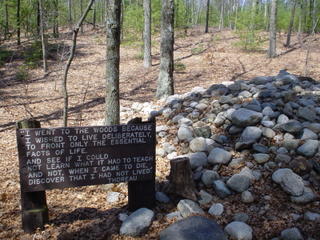
Amusing, yes. Confusing, absolutely. How could he not believe in that movie? Granted, it was a pretty outlandish plot, but the basic theme that tornados are destructive forces of nature that need to be better studied should have been completely understood by my father, who experienced this reality at full force. Yet, my father separated himself from not only the movie, but the discussion of such things.
American Christianity has formed its own sub-culture, and has defaulted to this same attitude that my father expressed when confronted with that Jan de Bont film. It is impossible for Christians in America today to not be aware of the progression of the culture in all its different directional tangents (this is often described as a "decline" by many in the Church). But, in their awareness, they have shrunk away like children from their father's cane. "Separation" or "isolation" are becoming more and more the fitting words to describe the Church in America.
I fell victim to this sub-culture, mainly because it is quite deceptive in that, from the outset, it comes across as scriptural. Two of the main passages from the Bible that are cited often to argue that Christians should keep the world at no less than arm's length are 1st John 2:15-17 and Philippians 4:8. And truth be told, the Bible does address the danger of immersing oneself in the world, of taking worldly ways upon oneself. Unfortunately for the sub-culture, never is there mentioned the words "separation" or "isolation." Yet, as a member of this sub-culture from high school through college, I followed the unwritten rules that included: not seeing movies that were R (or, if they were, could have no nudity or sexual references in them - apparently violence and foul language were not as bad); I only read books in the Christian publishing market; I did not support the sinfully promiscuous music industry by purchasing any "secular music;" and of course, weekends never included attendance in any bars, clubs, or questionable parties.
And so, around four years ago, I was crippled by the effects of a massive YAWN. I became so bored - so completely unlike anything I saw in society - that I felt not only very alone, but also extremely ineffective in sharing the love of Jesus Christ with anyone. While many do it everyday (entire children, youth, and college retreats are built around it every summer), I found that separating myself from everything in the world did not make me something special (someone God stood up and applauded) - it only made me excrutiatingly dull. If we were honest with ourselves - with our sinful condition, whether we are Christians or non - I think the idea of God applauding anything having to do with our willpower would be highly laughable. Let's face it, one of the main reasons Christ died is because our willpower to refrain from disobedience is practically non-existent.
But the argument remains, as does the tired youth group-ish question, "Are you "in" the world, "out" of the world, or "of" the world?" (If that confuses anyone, "of" is the bad answer.) And this argument, which is quite intricate and vitally important, I believe, to the future of the Church, boils down to one main thing: Fear. Christians who resign themselves to dwell within this sub-culture (to refrain from the extreme realities of the world, like the recognition of crime, alcohol, drug use, disease, promiscuity, sexual confusion, etc.) might not admit this, but it is not necessarily faithfulness to their clean & tidy God that keeps them in this bubble - it is fear of what exposure to what is outside the bubble might do to them, how it will compromise their purity, mount an assault on their salvation.
I was rescued from the sub-cultural bubble not by any person, so much as a love for good writing and good music and good story-telling, things of which the Christian sub-culture market has little. The first to go was my refusal to read books by non-Christian writers. Being an English major in college, I would have had a difficult time sticking to my guns on that one. In finally opening my mind to both classic and contemporary writers who do not cater to the Christian bubble (though I have found several who are very inspiring Christians), I discovered an exciting new world unfolding before me. But, oh, my reserved sub-culture spirit was sweating nervous bullets ... These days, the music I listen to and the movies I enjoy no longer meet the criteria of the bubble - they meet my own criteria.
Thanks to several in depth conversations that have taken place over the past four months (two big ones in the last three days, actually), I believe I can communicate this sufficiently, at least as far as I'm concerned:
There are two amazing realities in life that determine what I get involved / show interest in. Beauty and Redemption. This stems from my belief in the truth of Scripture, most specifically the Gospel of Christ. I believe God incarnated himself to reveal to humanity these two things. The Creator wanted to show humankind where Beauty could truly be found, and from whence it ultimately originated (in the Creator), and the Creator wanted to make humankind aware of the fact that they are all bent towards Redemption, that every person's "story" is one that is attempting (often struggling) to find redemption (which, according to Scripture, only finds ultimate fulfillment in the overarching, all-sufficient redemption of Jesus on the cross and out of the tomb). Jesus illustrated these two realities in many ways - parables, lessons, sermons, miracles, healings - but none so great as the way he simply spent the days of his life, constantly journeying and surrounding himself with the downtrodden, the dirty, and the despicable (those who, today, would without question dwell outside the bubble). I believe, without a doubt, that Jesus daily spoke of Redemption to them, as well as honestly saw them as Beautiful. He did not allow their degradation or their careless living or their constant rebellion to deter him from spending time with them, being the Light in their darkness.
We strive to be like Jesus, and we continually cite this truth that he hung out with the rejects of society as that which strikingly communicates the boundlessness of his love. But we cannot resemble this love or be like Jesus from our isolated position in the bubble. And because so many do not budge from the sub-culture, the sub-culture is despised (and we shrug this off and quote the scripture that Jesus said the world would hate us). In essence, we are afraid of the world.
I am convinced that the problem with "the world" is not what those who do not know God do, but what those who do know God don't do. Rich Mullins once said, "What amazes me is that God did not come up with any plan B. The Church is it - it is God's hope for the world."
I do not think I am contrary to the verse out of 1st John when I write, "I love the world." I do - I love it. I am a huge fan of it, as well as the One who made it. No, I do not indulge in drugs. No, I am not sexually promiscuous. No, I have never been drunk. In fact, surprisingly, I have found that I am incorrupted by the detriments of the world even though I listen to music by unsaved songwriters, I go and see movies in which drugs are used, crimes are committed, and every once in a while, someone is nude for whatever reason. But, truthfully, I don't see these things. I see a story of determination and bravery, of waking up to the Beauty and wonder of life. I see flawed, hurting characters stumbling through their story, desperate for redemption. And I think to myself, "THIS is real life. THESE are the kind of people to whom I am called to show God's love. THIS is the world - the reality - in which I need to dwell." God knows the bubble is not succeeding in this.
Last night, in a conversation on this very subject, my friend, Grayson, remarked, "I wonder if it is such a bad thing to be 'desensitized.'" He went on to tell a Beautiful story about a short conversation, saturated in grace, that he had with one of the prostitutes that works on his street corner. "I told her 'hello' and asked her how she was and then I just said, 'You look great. You are so beautiful,'" Grayson recalls. "I don't know where that came from, but I know, in that moment, I absolutely meant it. ... I think that is exactly how Jesus saw people." I'm afraid those in the bubble would never be able to experience a grace-giving friendship with the prostitutes on 15th street - they would have moved out of that neighborhood at the first sign of worldliness.
Frederick Buechner writes, "Needless to say, church isn't the only place where the holy happens. Sacramental moments can occur at any moment, at any place, and to anybody. Watching something get born. Making love. A walk on the beach. Somebody coming to see you when you're sick. A meal with people you love. Looking into a stranger's eyes and finding out he's not a stranger. If we weren't as blind as bats, we might see that life itself is sacramental."
I'm new to this, and I do not claim to have just presented the best reflection on this subject. But I think of the book of Proverbs, where Wisdom calls from the streets, to the "naive" and the "fools." She cries for them to bend an ear to her and to come to her in the streets, for, to those who are not afraid to come, she offers understanding, righteousness, and knowledge. She offers herself. She offers the truth of God.

Subscribe to:
Posts (Atom)


