Last week, I sat down and wrote the previous blog entry, "Leaving the Runway," in an effort to express the anxiety that I believe every Christian carries to some extent - that anxiety being the opposing forces of proof vs. faith. I was surprised to receive so many comments from people I did not know. Most of the people I know that read this blog rarely leave comments, so it is always a treat to be able to converse further over my thoughts and the feelings of others.
However, these comments were so varied in their critiques of what I wrote that, in one respect, I feel as if I am standing upon the crux of two see-sawing polar opposites when it comes to religious understanding. I hesitated at first to address these comments, but realizing they all came from thoughtful, intelligent people bringing, in their views, their own unique life experience, I feel now that to not address them would be a cop out. So, let me begin with the anonymous commenter on this, my Blogspot blog.
In order to conserve space and prevent this entry from stretching on too long, I will not include the entirety of "Anonymous'" quote, so if you would like to read it all, simply go to the entry just before this one and read the comments.
Anonymous (and even though there were two, I'm assuming it is the same person writing twice - even if I am mistaken, the sentiment in both is the same) came to my blog entry and was seemingly affected by a wishy-washiness he or she perceived in my reflection. What is more, Anonymous expressed concern that such an inability to cast away my anxiety and uneasiness of faith vs. proof might "infect" the youth group that I lead. Anonymous seemed upset that I would refer to the gospels as ambiguous, though, in reality, no matter how tightly one clings to the truth of the Gospels, only the naive would insist that there is no lack of information, that everything holds up perfectly and there is no reason to question anything. Unfortunately, many people cannot bring themselves to question the perspectives given to us in the gospels, let alone the validity of some of the details, even when one gospel differs slightly from other accounts. They simply cough out the "camera-angle" explanation, and bring into question the faith of the person calling parts of the gospels ambiguous.
Unfortunately for these people (and I'm not labeling Anonymous as one, though his sentiment reminded me of such people), the gospels, let alone the entire canon of Scripture, is ambiguous. It does not give us all the facts, and it does not answer every question and erase every doubt. For example, Genesis does not provide us with hard and fast proof of when and even how the earth was created. The Creation account is not a scientific dissertation. It is a narrative - a story - that delves beyond mere physical reasoning to the heart of the problem, that of human rebellion. In the same way, as I've told so many students in the youth group who have asked similar questions, Genesis is not an account of how the world began; it is an account of how God's relationship with man began, and that doesn't really start until chapter twelve with Abram.
The second thing that bothered Anonymous about my last entry was my closing metaphor, in which I try to paint a picture of what a life lived by faith is like, as opposed to a life lived solely by proof. Proof and certainty do not necessarily have to go together, as Hebrews 11:1 reminds us (and Anonymous attempted to remind me). However, faith and proof cannot go together, at least for a Christian. I was simply trying to illustrate that eventually, faith must stretch beyond proof. Anonymous wrote, referring to my metaphor, "I don’t believe that boarding the plane and leaving the runway is leaving something grounded, solid, or sure – if it was, no one would fly. In the same way, based on God’s promises, His real, historical, physical, incarnational provision of Christ, and His daily working in, through, and around us, we are convinced, sure, confident – full of faith, that what we hope for will happen. It isn’t a wishy-washy hope of uncertainty."
Quite true, and perhaps my use of the word "uncertainty" was a poor choice, but there are indeed two kinds of certainty. There is the certainty of proof, and there is the certainty of faith. These are not the same, as much as some of the "faithful" would like to insist they are. The certainty of proof is certain because it is "grounded," "sure," and scientifically provable. But faith has its own certainty, and it is not based on what is grounded or sure, no matter how true you believe the Bible to be (and I believe it to be quite true indeed despite it's ambiguous moments). The certainty of faith is found in our ability to hold to what we hope for no matter what goes on around us, what wars against our faith, and what challenges or shakes us to our core. Faith is a struggle, and as Paul Tillich intimated, it is not the opposite of doubt. Rather, doubt is one of the things that faith wraps itself around and redeems. Frederick Buechner writes of faith that it is "a journey without maps." So, ultimately, to those who dwell merely in the certainty of proof, the certainty of faith is not certainty at all, but uncertainty. However, for the faithful, as Anonymous is indeed one, faith is certainty. However, what we must all remember is that it is not the same as the world's view of what is and is not certain.
I am indebted to Anonymous for his or her comments, even if my metaphor was taken to some serious extremes to which no metaphor should ever be taken, and my ability to properly direct the youth under my charge was called into question. What Anonymous has helped me do is rethink my words and move even farther along this shadowy path we call earthly life.
There is still another pole which I need to address - a comment on my Xanga counterpart from a young man named Eric - before I can be finished with my response, but I will do this in another entry to come very soon. I think what I have written above is enough for us all - including me - to chew on.
The fundamental fact of existence is that this trust in God, this faith, is the firm foundation under everything that makes life worth living. It's our handle on what we can't see. The act of faith is what distinguished our ancestors, set them above the crowd. By faith, we see the world called into existence by God's word, what we see created by what we don't see. - Eugene Peterson's "The Message" translation of Hebrews 11:1-3
Showing posts with label Nearly Heretical. Show all posts
Showing posts with label Nearly Heretical. Show all posts
Tuesday, March 13, 2007


Monday, November 20, 2006
It Takes All Kinds
Thank you all for responding to the questions I posed in the previous entry. Please keep commenting if you would like, either on this entry or the one underneath. Every once in a while on this blog, I veer into an area of introspection or analysis that might run some people the wrong way, but I feel it's important to the greater theme of this, the search and continual discovery of the stuff of wonder, that we all take time to consider those things that detract from true faith or make an outright mockery of it.
To that end, before I give my (certainly misguided) two cents regarding the subject of the last post, I wanted to share something that initially seems funny but in reality is quite offensive and tragic, at least in my opinion. Yesterday I was driving down (or up, depending on where you are on it) San Felipe with Leigh on our way to an evening church activity when my eyes wandered to the right to read the latest marquee message of another church that I pass at least twice a day. In the past, this church has posted cutesy, mostly shallow messages, such as "What's missing from this ch ch?" However, on this week, the church sprinted past cutesy to downright offense. The latest marquee read:
Try Jesus. If you don't like him, the devil will always take you back.
My mouth fell agape immediately. In one simple statement, this church was purporting, to hundreds who would pass, a galling statement that is both poor theology and a perpetuation of an "us vs. them" mindset. I felt like calling the church and asking if they would tell all the insulted people that might call in to come to my church instead, where it seems we are slightly more careful in how we refer to those who have not professed a relationship with Christ.
I suspect that an us vs. them mindset pervades a majority of our thinking in churches today. This is not surprising, because, on the surface, Scripture itself often seems to read this way, whereas a deeper, more patient reading of Scripture gives us a more compassionate and gracious understanding of those "outside of Christ." I do not claim to always succeed in the latter kind of reading. However, I do think such a mindset affects many church decisions, from evangelistic strategies, to membership requirements, to church discipline.
I do not think this girl (introduced in the previous entry) is outside of Christ. Some may look at her lifestyle and suspect a Christian would not live the way she has, but then again, such an ideal Christian certainly wouldn't live the way I have either. The truth is, we all stand in need of great grace. And this is the one kink in my understanding that keeps me from agreeing whole-heartedly with those of you who commented in affirmation on the process of discipline described in the previous entry. I'm with Grayson in this respect. Where, then, is grace? It seems expulsion upholds a limited love, and though there is much Scripture that lays out somewhat specific disciplinary rules, I have trouble reconciling expulsion with being the body of Christ, which simply means to love as the Savior loves, unconditionally, unceasing...
If such a thing were to take place in my own church, I suspect I would find myself between a rock and a hard place, and therefore would have to make a decision, because, sadly, the above paragraph seems to be no real decision at all. But expulsion? I like Chris' and Natalie's comments (on this blog's Xanga doppelganger) regarding why this girl and her new husband should not be allowed to continue to attend regular worship and weekly bible studies, as long as they are no longer counted on to teach. We wouldn't keep out others with acute problems with sin, so why them? Is not separation of leadership enough?
I suppose bad company corrupts good character, but if there is any community that should remain unafraid of this, I think it should be the Church, of which Jesus once said, "the gates of Hades will not prevail against it." (Matthew 16:18)
Thursday, November 16, 2006
Disciplinarians
Last night, I was catching up on life and all its beautiful absurdity with my friend back home. In the midst of informing me of all the new engagements, marriages, pregnancies, etc., he shared with me the story of a young woman whom I know and have been privy to some of her headstrong mistakes and misjudgments. For privacy sake, I won't divulge any names.
It seems that this girl (several years younger than me) has been struggling with issues of purity and relationships since she hastily married in her early college years and was divorced soon afterwards. Following this, she returned to her hometown and commenced to serial dating. Added to her dating outlook was the practice of sleeping with the guys she was dating. This was not merely for the enjoyment of it, but, she insisted then and still does today, a necessary act to make sure the guy was right for her.
After several relationships lived out by this standard (a few that emotionally hurt some friends of mine when she grew tired of being with them), she has finally settled down with another guy (who seems quite nice), and is now pregnant with his child. They have lived together for some time, but only recently got married. She is in her third trimester with the child.
The question I would like to raise on this blog is not about her, but about what has transpired in my home church since all of this came to light (and it was not all at once, as many people knew of her outlook and her activity for quite a while). Unashamed of her promiscuous ways while dating and living with a man she was not yet married to, she has shared many times with many girls that none of this is a sin or against Scripture. Recently, it came to a point where, after several conversations with her alone as well as with her and her new husband, the leaders of the Singles/Young Couples group at the church (a long-time married couple) have asked them to leave the church. The leaders are taking quite seriously the statutes of 1st Corinthians 5 and Matthew 18:15-20, which lead them to expel the young woman and her husband.
My question is this: Do you feel this is the right move, as much as it matches with Scripture? Do you think the leaders and the church are right in expelling them from fellowship? My concern is that church discipline isn't what it used to be, when only one church existed in every city. Separation from fellowship might have worked well back in the early church, but today it seems that this couple could simply church hop and eventually find a community that looks the other way to any and every little thing they've done. And would that be so bad to look the other way?
Let me know what you think...
Thursday, September 21, 2006
The Substance of Things Hoped For
When did confidence become synonymous with faith? At what point did a a person's belief in God hinge on how much he or she took at face value, and how little was questioned? Such a question has become almost like a riddle to me these days, as if the answer might come like a punchline, and I would have to nod, scratch my head, and mumble, "Ohhh..." when falls the answer.
As I have shared in earlier posts regarding my own journey in and through faith, I was once taught that Hebrews 11:1, "Now faith is being sure of what he hope for and certain of what we do not see," could be translated by injecting the word "certain" in place of "hope," thus rendering the verse, "Now faith is being certain of what we are certain of and certain of what we do not see." In other words, with faith there are no questions, because if one is certain, one needs not seek clarification.
As is often the case, the NIV sits somewhere between a good translation and a bad one. The NASB works well, especially in the use of the word "conviction." And, as is often the case, the Contemporary English and Holman Christian Standard versions fail miserably in capturing the mystic nature and weight of this single verse. To test most of the translations, go here and have a ball.
It is the King James Version that wins the gold ribbon in my opinion. It reads, "Now faith is the substance of things hoped for, the evidence of things not seen." Many who read this might shrug and mutter, "What's the difference?" Perhaps I am nit-picking diction, but this version of the verse frees me rather than binds me. I do not mean to imply that I'm trying to manipulate Scripture so that I might have it read the way I want it to. On the contrary, I mean only to rescue Scripture from a Western thought-process that seeks facts over story, definition over mystery.
In our society, in our culture, we desire answers. We want results. We need proof. We bank on reasons. This is a remarkably different mindset than the days of the Old Testament, and even the days of Jesus, where Hellenistic (Greek) culture was already washing across much of the civilized world. Mystery was accepted in OT time. Not all things needed proof. The facts of a story were not nearly as important as the story itself. This is why there is so much vengeance, lament, doubt, and challenging of God in the Psalms and the Prophets. People were not expected to shut up and take everything with no questions, no concerns, no emotion exhaled. Apologists will point to the reason for the forbidden tree in Eden being that God did not want humans to be puppets and therefore blessed us with free choice, but then they will try to boil the movement and existence of God down to provable facts. What kind of freedom of belief is that? I've got news for them (and all of us): it does not, and will never, work that way.
God dwells in mystery, and he does not condemn us when we do not understand, when we doubt, and when we question. He wants us to wrestle with him - why else would he stalk Jacob in the wilderness? He boomed at Job, not for his questions, but because his questions had left the realm of doubt and moved on into despair. And, in the end, that is what the opposite of faith is - despair. Not doubt.
So, let me wrestle with my God. Let me collide with him. Let me question his ways, and seek to understand the sobering truth: that I will never fully understand him. On the other side of these things lies the substance of things hoped for, true faith.
Wednesday, March 01, 2006
Life Isn't Fair
When I was a child and would protest to my parents regarding any number of disagreements, I would often receive a simple statement dropped with such finality in tone and definitiveness that it would frustrate me to no end. "Well, Vernon, life isn't fair."
I hated this statement, not just because it held a lot of truth, but because I refused to believe such a sweeping, general statement could be relevant anti-explanation to my every objection, from the largest offense to the most minute. Life had to be kind of fair, didn't it?
In reality, life is quite fair, quite just, despite all the examples we see of injustice ... from wars springing from sordid reasons, criminals acquitted thanks to the power of their money, innocent men and women convicted because of poor defense, misleading politicians, the trampling of the poor, the neglect of the sick and dying ... Despite all of this, life is more fair than we realize. The majority of people still get what they deserve, mainly because this is the way most of humanity functions. Karma reigns in many places throughout Asia, and in the West, our churches close the doors on homosexuals, liberals, homeless, and any poorly dressed people we think made their own bed and should therefore, quite fairly, lie in it.
The past few posts have taken me on a voyage of thought I have never truly felt comfortable with, and that not because I couldn't formulate a clear answer, but because I feared if I did formulate a clear answer it would subsequently contort me into a person who, to some group of people or another, turned a cold shoulder ... in the name of what is "true" and "just."
Today is Ash Wednesday, and the beginning of the season of Lent. Both are marked by repentance, penitence, and supplication. During this time, Christians scrape and strive to make sense of the ramifications of what it took for Christ to achieve atonement for all humanity, past and present. And gradually, I come to realize just how offensive, just how unfair, is the lot of the Savior. A good man - a man who experienced every chief emotion, temptation, and challenge we experience, yet resisted rebellion, remained untouched by the nature of Sin. When we come down to it, we find the most unjust of events taking place to accomplish the justice of God.
But still we make it our place to determine who will be with Christ in Heaven and who will "burn in Hell." Some Christians incorrectly defend their judgmentalness by quoting obscure verses in Scripture about the saints judging the nations. These are the same people who clutch their Bibles like a gavel. However, I think we might be surprised just who are revealed to be the true saints mentioned in Scripture. In a comment on my last post, my friend Meg quoted Richard John Neuhaus: "Jesus is not very fastidious about the company he keeps. A serious question is raised about whether we will be happy with those who are with us in paradise."
I believe that one day all our opinions and biases and misguided loyalties will be swallowed up in the stark image of the unjustly nail-scarred hands of a God who became a baby, who became a prophet, who became a Savior, who became a King. Today I think of a head pierced deep by thorns, blood pouring ... of splintered hands pinned to a tree ... of a ravaged side run through with a spear ... of dusty feet caked with blood.
It seems my parents were indeed right - perhaps more right than even they knew. Life ... true life ... isn't fair.

Tuesday, February 14, 2006
Great Souls
In Lord Richard Attenborough's film, Gandhi, there is a remarkable scene that takes place toward the end of the Great Soul's days, as terrorists responsible for the violence in Calcutta and other regions of India come to him to lay down their weapons at his bed, determined not to continue their violent ways and so cause Gandhi to perish by fasting unto death. An angry Hindu man rushes to the bedside and shoves bread into the Mahatma's face, demanding he eat. The man refuses to have Gandhi's death on his conscience. He confesses he is damned and tells of recently killing a Muslim child. Still very weak from his fast, Gandhi says to the distraught man, "I know a way out of hell." He tells the man to go, find an orphaned Muslim child, and adopt him as his own son. "But," Gandhi tells the man, "you must be careful to raise him as a Muslim." The man is shocked - so would any of us be who translated this scene into our own lives. All my Western Christian brain could think at that moment was, "But the child would be Muslim. And the man is still Hindu. They're both going to hell."
Why do great souls like Gandhi, Buddha, and Rabbi Abraham Heschel go to hell, after all they have done to direct humanity away from selfishness and into the recognition of the transcendent, transforming love of God? The obvious answer - the answer I grew up with - is that this has nothing to do with what they did in life. What they did was highly commendable, but Ephesians 2:8-9 blares out the truth all the same, "For by grace you have been saved through faith; and that not of yourselves, it is the gift of God; not as a result of works, so that no one may boast." As Christians, especially as Protestants, we hold to this truth with an iron fist. We clarify it as meaning one thing: there is nothing we can do to earn salvation. However, what is remarkably absent from this true and wonderful statement is the "way" that we can find salvation. Christians today inject a doctrine after this verse, and it normally takes the form of praying for the forgiveness of all your sins and accepting Jesus' death on the cross as the atoning sacrifice that covers us from the consequence of sin, which is death. I am not denying this doctrine. I am questioning its placement and its form.
Ephesians 2:8-9 rejects the idea of earning salvation by living in such a way as to impress God. In reality, salvation comes only as a free gift, bestowed upon all whom he chooses to save, no strings attached, no prerequisites required. However, the Church has established a prerequisite of its own - the salvation prayer. Though the original form of this prayer was of complete supplication, complete rejection of all worth and merit, it has become a "work" of its own. If you don't "do" it, you don't get in to Heaven. It has become the initial hurdle to leap over as you "run the race" (1st Cor. 9:24).
What is the salvation prayer supposed to be? Is it only poignant words prayed that hold sway over your life throughout all your days? Or is it the expression of a change of heart that takes place allowing us to expel the things of this world in eager expectation of the things to come? Is it vainly seeking rescue from Hell (as it was with me at the fearful age of 8)? Or is it praying the theme of a life given over in humility to a great and gracious God?
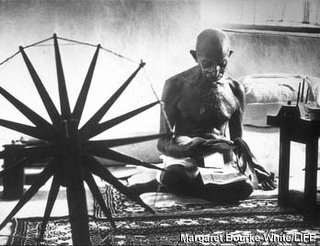
I look at the life of Gandhi and Rabbi Heschel and other great figures whom we assume never "acquired the faith" and therefore shall spend eternity in torment. Maybe so. But if the way a life is lived is to be any proof of the desires of one's heart and the passion of one's soul, Gandhi is truly redeemed, whether he mumbled a sinner's prayer or not. And we ... we are damned. I worry about whether or not I will find a job in Houston once I graduate? Gandhi worried about the masses of Untouchable's littering the streets of the cities of India. Much of the quiet moments of thinking during my day is focused on my future with Leigh, where we might live, what the future holds for us. Gandhi's quiet moments were spent considering new ways to unite all the people of his country in love and mutual respect, across even violent religious lines. I sweat over how I might prove myself a talented writer and an innovative minister. Gandhi calmly spent his time praying and weaving his own clothes. I occasionally erupt into anger when I want to be recognized as right. Gandhi softly said, "An eye for an eye only ends up making the whole world blind."
Who is truly humbled before God? Who is truly saved?
Thank you, God, that there is never-ending grace. I cannot earn it, and nothing I offer can ever affect it, even the most soul-stirring of prayers.
Why do great souls like Gandhi, Buddha, and Rabbi Abraham Heschel go to hell, after all they have done to direct humanity away from selfishness and into the recognition of the transcendent, transforming love of God? The obvious answer - the answer I grew up with - is that this has nothing to do with what they did in life. What they did was highly commendable, but Ephesians 2:8-9 blares out the truth all the same, "For by grace you have been saved through faith; and that not of yourselves, it is the gift of God; not as a result of works, so that no one may boast." As Christians, especially as Protestants, we hold to this truth with an iron fist. We clarify it as meaning one thing: there is nothing we can do to earn salvation. However, what is remarkably absent from this true and wonderful statement is the "way" that we can find salvation. Christians today inject a doctrine after this verse, and it normally takes the form of praying for the forgiveness of all your sins and accepting Jesus' death on the cross as the atoning sacrifice that covers us from the consequence of sin, which is death. I am not denying this doctrine. I am questioning its placement and its form.
Ephesians 2:8-9 rejects the idea of earning salvation by living in such a way as to impress God. In reality, salvation comes only as a free gift, bestowed upon all whom he chooses to save, no strings attached, no prerequisites required. However, the Church has established a prerequisite of its own - the salvation prayer. Though the original form of this prayer was of complete supplication, complete rejection of all worth and merit, it has become a "work" of its own. If you don't "do" it, you don't get in to Heaven. It has become the initial hurdle to leap over as you "run the race" (1st Cor. 9:24).
What is the salvation prayer supposed to be? Is it only poignant words prayed that hold sway over your life throughout all your days? Or is it the expression of a change of heart that takes place allowing us to expel the things of this world in eager expectation of the things to come? Is it vainly seeking rescue from Hell (as it was with me at the fearful age of 8)? Or is it praying the theme of a life given over in humility to a great and gracious God?

I look at the life of Gandhi and Rabbi Heschel and other great figures whom we assume never "acquired the faith" and therefore shall spend eternity in torment. Maybe so. But if the way a life is lived is to be any proof of the desires of one's heart and the passion of one's soul, Gandhi is truly redeemed, whether he mumbled a sinner's prayer or not. And we ... we are damned. I worry about whether or not I will find a job in Houston once I graduate? Gandhi worried about the masses of Untouchable's littering the streets of the cities of India. Much of the quiet moments of thinking during my day is focused on my future with Leigh, where we might live, what the future holds for us. Gandhi's quiet moments were spent considering new ways to unite all the people of his country in love and mutual respect, across even violent religious lines. I sweat over how I might prove myself a talented writer and an innovative minister. Gandhi calmly spent his time praying and weaving his own clothes. I occasionally erupt into anger when I want to be recognized as right. Gandhi softly said, "An eye for an eye only ends up making the whole world blind."
Who is truly humbled before God? Who is truly saved?
Thank you, God, that there is never-ending grace. I cannot earn it, and nothing I offer can ever affect it, even the most soul-stirring of prayers.
Tuesday, February 07, 2006
Dry-Erase Board Salvation
When considering the questions I posed in my previous entry, a flood of poignant quotes have leapt to my mind, but none so timely as a short passage from Peter De Vries book, The Blood of the Lamb. I find myself not so much questioning the specifics of salvation as much as I am reacting against the presumption of who meets the criteria and who doesn't - that it is so black and white. In his novel, De Vries' main character, Don Wanderhope, wrestles with the ever-present question of theodicy (why does God allow evil/tragedy?). At one point, Don seeks the council of his doctor after the sudden death of a woman he loved dearly:
I set my brandy down and said: "Dr. Simpson, do you believe in God?"
I think of this passage often now, while considering salvation.
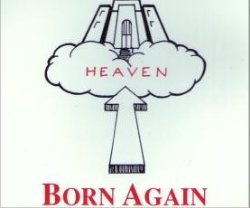
It certainly seemed like an easy answer when I was young. My first encounter with the traditional, evangelical "plan" of salvation occurred midway through Vacation Bible School at the small Baptist church of my youth. In what became somewhat of a ritual to be revisited every year, the pastor would lug out an easel and a dry-erase board and with his four colored markers, he would crudely draw the earth suspended above a void of black with the word "HELL" written within in, and stretched above the planet would be written "HEAVEN," nestled in bubbly clouds. A stick figure would stand upon the earth, and the pastor would explain to the older VBS'ers (normally Kindergarten through sixth grade, those who were deemed able to comprehend this weighty concept) that there existed a separation between Heaven and those on earth. He would shade in this demilitarized zone of separation with the black marker and write "SIN" within it. He would then go on to explain how Jesus' death on the cross bridged this gap. Arrows shooting from the stick figure toward Hell were reversed, pointing to Heaven, and the black span of sin was pierced with a red cross stretched between earth and eternity.
Cut and dried; tried and true. The basic foundation of Christianity.
The one vaguery that I did not recognize at the time (and perhaps this was the blessing of having a child-like faith - I was not yet cursed to dwell within reason's cold realm) was the belief issue. What did it take to navigate through this black void of sin upon the blessing of the red cross? The answer: belief in Jesus, specifically illustrated in a personal prayer that he forgive me of my sins. Which sins? All of them? Was it belief that he could forgive me, or would forgive me? Was it more than belief regarding supplication to him, but belief in his life-changing power? And what did such a changed life look like?
The question I struggle with now is, what form does this prayer for forgiveness take in people's individual lives. Many believe it must be as black and white as it was presented me as a child, but these are often the same people who care nothing for discipleship - really learning to live like Jesus - and would rather check off as many names on their outreach lists as possible; if they've prayed the prayer, God has got to let them in. After all, through the grace of the cross, we have a deal ...
The second problem with viewing salvation as obtainable only by means of a prayer for forgiveness is that the actual concept to which Christ called us becomes an afterthought. The gospel accounts are replete with instances of Christ commanding his followers to do just that, follow him. And his description of what this actually looks like, use of hyperbole notwithstanding, rarely includes the saying of a prayer. Instead, it involves people feeding the hungry, giving to the poor, selling their possessions, forgetting their family for the sake of followship.
This is enough for now, but in a few days I will be returning to these two problems, especially in examining the lives of people most Christians today do not consider to be Christians, such as Gandhi and Rabbi Abraham Heschel. The question I will pose is: why are such people as them bound for HELL, and people like Pat Robertson, Jerry Falwell, and the despicable Vernon Bowen soaring to HEAVEN?
I set my brandy down and said: "Dr. Simpson, do you believe in God?"
He just perceptibly raised his eyes, as if in entreaty to Heaven to spare him at least this. It took me some years to attain his mood and understand my blunder. He resented such questions as people do who have thought a great deal about them. The superficial and the slipshod have ready answers, but those lookng this complex life straight in the eye acquire a wealth of perception so composed of delicately balanced contradictions that they dread, or resent, the call to couch any part of it in a bland generalization.
I think of this passage often now, while considering salvation.
It certainly seemed like an easy answer when I was young. My first encounter with the traditional, evangelical "plan" of salvation occurred midway through Vacation Bible School at the small Baptist church of my youth. In what became somewhat of a ritual to be revisited every year, the pastor would lug out an easel and a dry-erase board and with his four colored markers, he would crudely draw the earth suspended above a void of black with the word "HELL" written within in, and stretched above the planet would be written "HEAVEN," nestled in bubbly clouds. A stick figure would stand upon the earth, and the pastor would explain to the older VBS'ers (normally Kindergarten through sixth grade, those who were deemed able to comprehend this weighty concept) that there existed a separation between Heaven and those on earth. He would shade in this demilitarized zone of separation with the black marker and write "SIN" within it. He would then go on to explain how Jesus' death on the cross bridged this gap. Arrows shooting from the stick figure toward Hell were reversed, pointing to Heaven, and the black span of sin was pierced with a red cross stretched between earth and eternity.
Cut and dried; tried and true. The basic foundation of Christianity.
The one vaguery that I did not recognize at the time (and perhaps this was the blessing of having a child-like faith - I was not yet cursed to dwell within reason's cold realm) was the belief issue. What did it take to navigate through this black void of sin upon the blessing of the red cross? The answer: belief in Jesus, specifically illustrated in a personal prayer that he forgive me of my sins. Which sins? All of them? Was it belief that he could forgive me, or would forgive me? Was it more than belief regarding supplication to him, but belief in his life-changing power? And what did such a changed life look like?
The question I struggle with now is, what form does this prayer for forgiveness take in people's individual lives. Many believe it must be as black and white as it was presented me as a child, but these are often the same people who care nothing for discipleship - really learning to live like Jesus - and would rather check off as many names on their outreach lists as possible; if they've prayed the prayer, God has got to let them in. After all, through the grace of the cross, we have a deal ...
The second problem with viewing salvation as obtainable only by means of a prayer for forgiveness is that the actual concept to which Christ called us becomes an afterthought. The gospel accounts are replete with instances of Christ commanding his followers to do just that, follow him. And his description of what this actually looks like, use of hyperbole notwithstanding, rarely includes the saying of a prayer. Instead, it involves people feeding the hungry, giving to the poor, selling their possessions, forgetting their family for the sake of followship.
This is enough for now, but in a few days I will be returning to these two problems, especially in examining the lives of people most Christians today do not consider to be Christians, such as Gandhi and Rabbi Abraham Heschel. The question I will pose is: why are such people as them bound for HELL, and people like Pat Robertson, Jerry Falwell, and the despicable Vernon Bowen soaring to HEAVEN?

Saturday, February 04, 2006
I Wonder as I Wander
Right now on channel 45 there is a portly, well-dressed preacher pacing behind an expensive glass podium in a church building that is more of a Ryman Auditorium than a sanctuary. Stretched behind him is a massive mural with vivid images and words under each: "marriage Covenant", "Salt Covenant", "Blood Covenant" and "Israel Covenant." He tells the congregation (or is it just an audience?) that these are the subjects of the sermons he will be preaching over the next few weeks. He wears a bright yellow tie with an elegantly matching handkerchief, and as he speaks he gestures forcefully with his arms. From what I've listened to before deciding I've heard enough, this preacher is proclaiming that America was also founded on a covenant, and he mentions the Mayflower and the founders of America who he no doubt believes were all "good Christian men." He tells his hearers that God has blessed America more than any nation in the world and, as the Bible reads, God promises to continue doing so if America abides within the laws of this covenant. Unfortunately, the preacher goes on to lament that America is rejecting this covenant. His first example is that America has thrown out the Ten Commandments from the schools. He describes the breakdown in families. He mentions climbing divorce rates and something about Britney Spears which I think is meant to be well-placed humorous jab in the sermon ...
He, and I'm sure many people in the pews before him, are so very, very sure they are Christians. They are certain that they are heavenbound.
_______
It is a wonder we are alive at all, let alone have a God who loves us no matter who we are, what we do, or what we say.
Over this next week, I am going to be writing reflectively about salvation. Specifically, I am going to be mulling over the question of just who is saved, and how exactly does one become saved. Is it by simply saying (or reading or repeating) a prayer? Is there another way besides praying? Do "works" really have nothing to do with it? Do only the Christians get in?
I've wrestled with whether or not this is a subject I want to introduce to my blog - I'd much rather dwell on the lighter side of life, and leave controversy on the sidelines. However, I remember that I started this blog as a personal exercise to reflect on the wonders of God and the joy of life. I wanted to have a place where I could offer my meager comments on this beautiful story of redemption we all exist in, whether we have realized it or not. And I cannot imagine anything more integral to this story than the very rhythm of salvation itself. If it is a grand redemption we are meant to find, how then do we find it, and what does one have to do, essentially, to experience it?
I hope you who read this blog - there cannot be many of you - will be merciful with my wanderings. I also hope you will offer as many comments as possible. I don't plan to stumble upon any clear-cut answers, but reading what others think is one way for us all to sharpen our eyes and strengthen our limbs for the journey.
So, what do you think is essential for a person to find salvation - for a person to go to heaven? Or what have you always learned regarding such a question? This will be the first thought on which I'll post in a few days ...

Subscribe to:
Posts (Atom)


